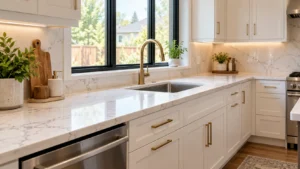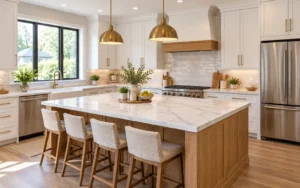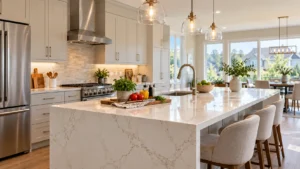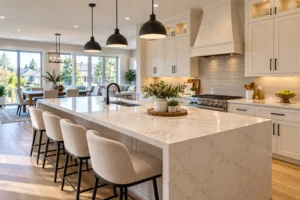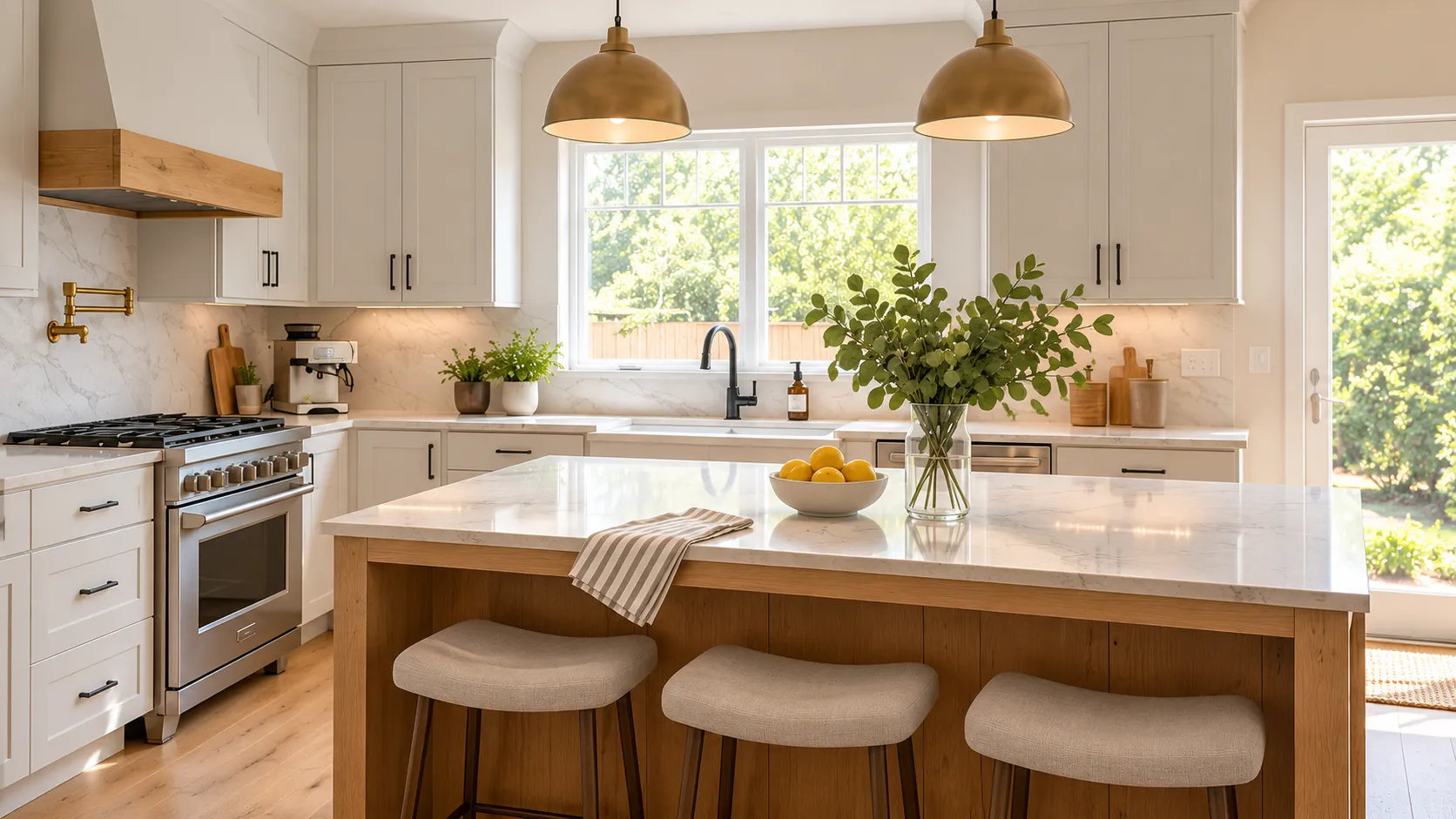
Choosing between matte vs polished quartz countertops is about more than deciding whether you prefer a soft, understated surface or a glossy, reflective finish. The right countertop finish can influence how your kitchen looks under natural light, how visible everyday smudges become, how easily you clean the surface, and how well the finished space complements your cabinets, backsplash, flooring, and overall interior design.
For homeowners planning a kitchen renovation in Kitchener, Ontario, both matte and polished quartz offer attractive options. Each finish brings a different visual character to the room, and both can work beautifully in contemporary, traditional, transitional, and minimalist kitchens.
However, there are important differences to consider before making your final decision. Matte quartz creates a subtle, low-sheen appearance, while polished quartz reflects light and enhances the depth of colours and patterns. Their cleaning requirements can also differ depending on the manufacturer, surface texture, colour, and the types of marks that appear during everyday use.
At Cava Granite, homeowners can explore custom quartz countertop options and receive professional guidance on choosing a surface that suits their renovation goals. This guide explains the differences between matte and polished quartz countertops, compares their advantages and disadvantages, and helps you determine which finish makes the most sense for your home.
What Is the Difference Between Matte and Polished Quartz Countertops?
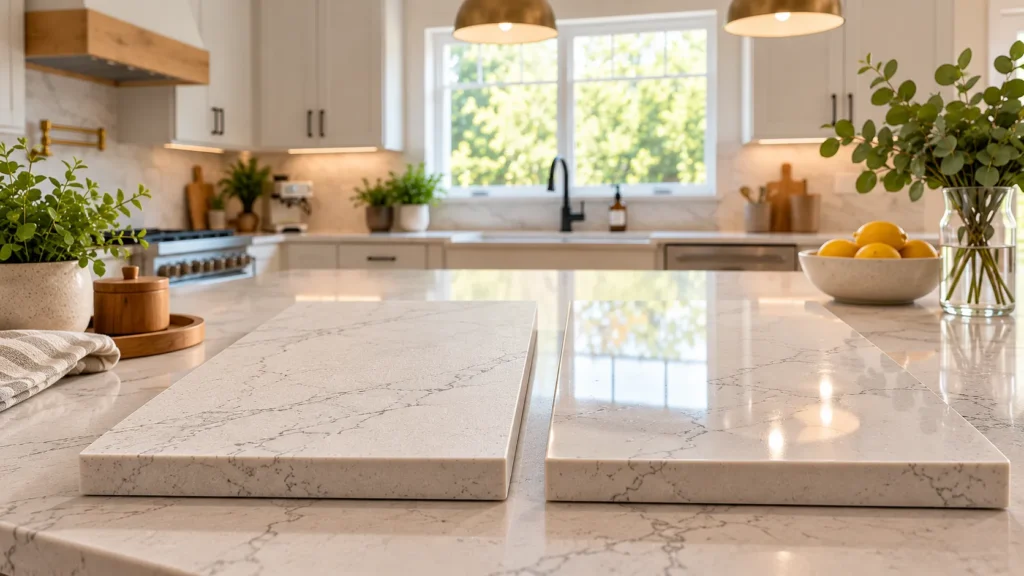
The primary difference between matte and polished quartz countertops is the way their surfaces reflect light.
Polished quartz has a smooth, glossy surface that reflects light, highlights colour variations, and gives the countertop a refined appearance. Matte quartz has a low-sheen finish that produces less reflection and creates a softer, more understated look.
Both finishes are available on selected engineered quartz products. Their performance depends on the specific product, its composition, manufacturing process, and the manufacturer’s care recommendations.
What Are Matte Quartz Countertops?
Matte quartz countertops feature a low-reflective surface that creates a calm, contemporary appearance. Depending on the product, the finish may also be described as honed, although the exact texture and sheen can vary between manufacturers.
Unlike a glossy countertop, matte quartz does not create strong reflections from windows, pendant lights, or under-cabinet lighting. Instead, it allows the colour and pattern of the material to contribute to the kitchen’s overall design without drawing attention to surface shine.
Matte quartz works particularly well in kitchens that feature natural wood cabinetry, warm neutral colours, textured backsplashes, and minimalist hardware.
Common design applications include:
- Contemporary kitchens with flat-panel cabinets.
- Scandinavian-inspired interiors with natural wood and neutral colours.
- Modern farmhouse kitchens with understated finishes.
- Minimalist kitchens where visual simplicity is a priority.
- Kitchen islands designed to create a subtle architectural focal point.
Matte finishes can make a kitchen feel relaxed and sophisticated without relying on high gloss. Nevertheless, the actual appearance depends on the selected quartz colour, pattern, lighting, and surrounding materials.
What Are Polished Quartz Countertops?
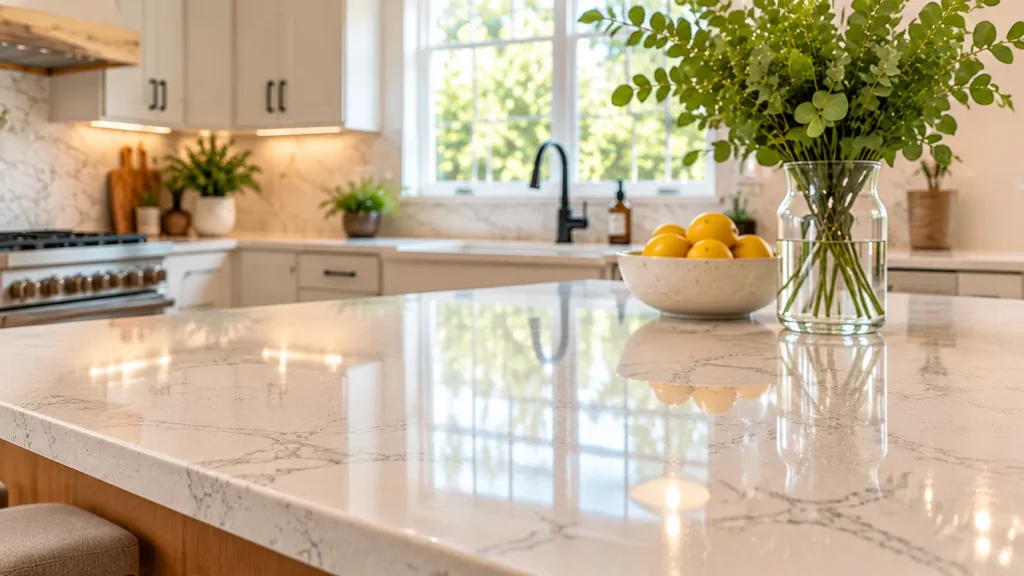
Polished quartz countertops feature a smooth, glossy surface that reflects more light than matte quartz. This reflective quality can make colours appear more vivid and give veining or decorative patterns greater visual depth.
Polished quartz is a popular choice for homeowners who want a bright, clean-looking kitchen with a timeless finish. It pairs particularly well with white cabinetry, contemporary hardware, marble-inspired patterns, and traditional kitchen designs.
Common applications include:
- Bright white kitchens with light-coloured cabinets.
- Luxury kitchens with marble-look quartz islands.
- Traditional kitchens with classic cabinet profiles.
- Smaller kitchens where additional light reflection is desirable.
- Bathrooms and vanity areas that benefit from a refined appearance.
Polished quartz is also generally straightforward to wipe clean because of its smooth surface. However, water spots, fingerprints, dust, and fine scratches may become noticeable under certain lighting conditions.
Matte vs Polished Quartz: A Quick Comparison
| Feature | Matte Quartz | Polished Quartz |
| Appearance | Soft, understated, contemporary | Glossy, bright, refined |
| Light reflection | Low | High |
| Colour appearance | Subtle and restrained | Often appears more vivid |
| Visible fingerprints | Depends on colour and product | Can be noticeable under direct light |
| Water spots | May remain visible, especially after drying | Can show as reflective marks or mineral deposits |
| Cleaning | May require additional attention with some finishes | Usually easy to wipe clean |
| Scratch visibility | Depends on texture, colour, and lighting | Fine marks can catch reflected light |
| Design compatibility | Minimalist, modern, natural interiors | Traditional, contemporary, transitional interiors |
| Routine sealing | Generally unnecessary for engineered quartz | Generally unnecessary for engineered quartz |
| Best selection method | Inspect an actual sample | Inspect an actual sample |
Important: These are general tendencies, not universal rules. Some matte quartz products are exceptionally easy to maintain, while some polished colours show everyday marks more readily than others. Always check the specific manufacturer’s technical specifications and care instructions.
1. Appearance and Interior Design: Which Finish Looks Better?
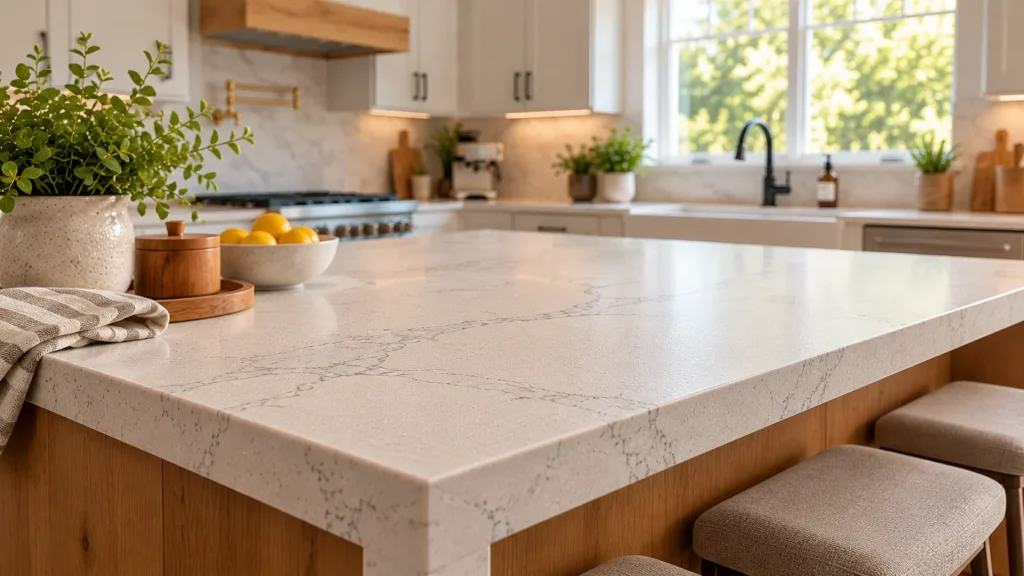
There is no universally better finish. The most suitable option depends on the atmosphere you want to create and how the countertop interacts with the rest of your kitchen.
Matte Quartz for a Subtle, Modern Appearance
Matte quartz is an excellent option if you prefer a contemporary kitchen that feels balanced rather than highly reflective.
Its low-sheen surface works particularly well when several materials are used together. For example, a matte quartz island can complement oak cabinets, brushed metal handles, warm flooring, and a textured backsplash without introducing too many competing reflective surfaces.
This finish can also be attractive in open-plan homes where the kitchen connects directly to a living or dining area. A quieter surface helps the countertop blend naturally with the surrounding interior.
Consider matte quartz if your design priorities include:
- A restrained, sophisticated appearance.
- Minimal surface glare.
- A natural-looking colour palette.
- Visual consistency with matte cabinets and hardware.
- A contemporary design that avoids excessive shine.
One consideration is that matte quartz does not automatically make every kitchen look warmer or more luxurious. Dark matte surfaces, for instance, can create a dramatic appearance, while light matte surfaces often feel soft and understated. The colour and pattern still matter considerably.
Polished Quartz for a Bright, Refined Appearance
Polished quartz is a strong choice when you want the countertop to become a prominent visual feature.
Its reflective surface interacts with natural and artificial lighting, making it especially appealing in kitchens with white cabinetry, pale flooring, and light-coloured walls.
Polished white quartz with subtle grey veining can create a marble-inspired appearance without requiring the homeowner to choose natural marble. Meanwhile, darker polished quartz can add contrast and sophistication to lighter cabinets.
Choose polished quartz if you want:
- A glossy, elegant surface.
- Colours and patterns that stand out.
- A countertop that complements reflective fixtures.
- A classic appearance that works across multiple design styles.
- A bright, visually open kitchen.
If your kitchen already contains glossy cabinets, reflective tiles, and stainless-steel appliances, consider whether another reflective surface will create a balanced result. A matte finish may introduce useful contrast.
How Cabinet Colours Influence Your Choice
Your cabinetry is one of the most important factors when comparing countertop finishes.
White cabinets work well with both matte and polished quartz. A polished surface can create a bright, seamless appearance, while matte quartz can add a softer contrast.
Natural wood cabinets often pair beautifully with matte beige, cream, or warm grey quartz. However, polished quartz can also work well when you want to introduce brightness or highlight a distinctive pattern.
Dark cabinets can create a dramatic combination with either finish. Matte quartz may reinforce an understated, modern aesthetic, while polished quartz can provide additional contrast through reflected light.
Before selecting a finish, compare it with your actual cabinet sample rather than relying exclusively on online photographs.
2. Durability and Scratch Resistance: Is Matte or Polished Quartz Better?
Durability is a major consideration for busy households, particularly when choosing a kitchen island or a countertop used for frequent food preparation.
The important distinction is that the finish alone does not determine the structural durability of an engineered quartz slab.
Both matte and polished quartz can offer strong everyday performance. Their scratch resistance, impact resistance, and other technical characteristics depend on the specific product and its manufacturing specifications.
Does Matte Quartz Resist Scratches Better?
Matte quartz may disguise some minor surface marks because it produces less reflected light. Small imperfections can be less conspicuous when they do not interrupt a glossy reflection.
However, this does not mean that every matte quartz product is more scratch-resistant than every polished product.
A scratch can still occur, and abrasive cleaning tools or unsuitable products may affect the appearance of certain matte finishes. Textured surfaces can also make metal transfer marks or residue more noticeable in some circumstances.
If you regularly prepare food, move appliances, or use heavy cookware on your countertops, focus on the manufacturer’s durability specifications and recommended care practices rather than selecting a finish solely for perceived scratch resistance.
Does Polished Quartz Show Scratches More Easily?
Fine scratches on polished quartz can become visible when light reflects across the surface. The visibility of a mark depends on its depth, the countertop’s colour, the lighting angle, and the surrounding pattern.
A light-coloured polished countertop with substantial veining may conceal some marks better than a dark, uniform surface. The opposite can also occur depending on the type of damage and lighting conditions.
To protect either finish:
- Use a cutting board instead of cutting directly on the countertop.
- Avoid dragging heavy appliances or rough objects across the surface.
- Use trivets or heat-resistant pads beneath hot cookware.
- Follow the manufacturer’s recommendations for cleaning and maintenance.
- Take extra care around edges, seams, sink cutouts, and cooktop openings.
Quartz is durable, but it is not indestructible. Preventing damage is easier than trying to restore a surface after a scratch, chip, or heat-related defect occurs.
3. Maintenance and Cleaning: Which Quartz Finish Is Easier to Maintain?
Both matte and polished quartz countertops are generally low-maintenance options compared with many porous natural stone surfaces. However, low maintenance does not mean maintenance-free.
Routine cleaning requirements vary by manufacturer and finish. In particular, some honed or textured quartz surfaces can require more attention than polished alternatives because everyday residue, fingerprints, and metal marks may appear differently.
Cleaning Matte Quartz Countertops
Matte quartz is often selected because it creates a soft appearance and can reduce glare. However, the absence of gloss does not guarantee that the surface will hide every fingerprint or water mark.
Depending on the product, matte quartz may require more careful wiping to remove oily residue, dried spills, or cleaning-product buildup.
For routine care:
- Remove crumbs and loose debris with a soft cloth.
- Clean the surface using warm water and a small amount of mild dish soap.
- Wipe gently with a non-abrasive microfiber cloth or sponge.
- Rinse away any remaining soap residue.
- Dry the surface with a clean, soft cloth when appropriate.
Avoid abrasive scouring pads, aggressive scrubbing, and unapproved cleaning chemicals. These may affect the appearance or surface texture of some quartz products.
Cleaning Polished Quartz Countertops
Polished quartz is usually easy to wipe clean because its smooth surface does not have the same texture as some honed finishes.
For ordinary kitchen spills, mild dish soap and warm water are often sufficient. A soft microfiber cloth can help remove fingerprints, food residue, and light surface marks without unnecessary abrasion.
To keep the surface looking its best:
- Wipe up spills promptly.
- Use a soft cloth and a manufacturer-approved cleaner when necessary.
- Rinse away cleaning-product residue.
- Dry the countertop to reduce visible water spots and mineral deposits.
- Avoid harsh chemicals unless the manufacturer specifically approves them.
Polished quartz can still show dried water droplets, fingerprints, and fine scratches, especially when sunlight or directional lighting hits the surface.
Do Quartz Countertops Need Sealing?
Most engineered quartz countertops do not require routine sealing because their resin-bound composition is designed to provide a non-porous surface.
This is an important difference from natural stone products that may require periodic sealing.
However, always confirm the requirements of your particular countertop. Engineered quartz should not be treated as identical to granite, marble, porcelain, or other stone surfaces.
Applying an unnecessary sealer or wax can leave residue and may not improve the countertop’s performance.
Matte vs Polished Quartz: Everyday Maintenance Verdict
Polished quartz is often the more straightforward option for homeowners who prioritize quick cleaning. Certain matte or honed finishes can require additional attention to remove visible residue and maintain a consistent appearance.
Nevertheless, the colour and specific product can matter just as much as the finish.
For example, a light matte surface may suit a household that prefers a subtle aesthetic, while a patterned polished surface may be more forgiving than a uniform dark surface in another kitchen.
The best approach is to request the manufacturer’s care guide before purchasing and test a sample with ordinary household lighting.
4. Fingerprints, Water Spots, and Smudges: What Should You Expect?
One of the most common concerns when choosing between matte vs polished quartz countertops is how clean the surface will look between wipe-downs.
There is no finish that makes everyday marks disappear completely. Instead, the way light interacts with the surface influences how noticeable those marks become.
Fingerprints on Matte Quartz
Matte quartz may conceal some fingerprints because it does not create strong reflections. This can be useful on a frequently used island or a countertop near cabinet handles.
However, oily fingerprints can still leave visible patches, particularly on dark, uniform colours or certain surface textures.
If fingerprints are a major concern, compare samples using the same lighting and handle each sample with clean and slightly oily fingers. Then clean both according to the manufacturer’s instructions to see how easily residue is removed.
Fingerprints on Polished Quartz
Fingerprints may stand out on polished quartz when they disturb the surface’s reflective appearance. The effect varies with colour, lighting, and the amount of natural light entering the kitchen.
Some polished colours disguise fingerprints reasonably well, while others reveal them more clearly.
A quick wipe with a suitable microfiber cloth will often remove everyday fingerprints without difficulty.
Water Spots and Hard-Water Deposits
Water spots can appear on either finish. When water evaporates, it may leave mineral deposits behind, particularly in areas with hard water.
These marks are common around sinks, taps, soap dispensers, and frequently used preparation areas.
Wiping up standing water and drying the surface can help reduce deposits. For persistent marks, use only a cleaning product approved for the specific quartz surface.
Do not assume that a matte finish will eliminate water spots or that a polished finish will always make them more noticeable. Test your preferred colour and finish before committing to a full installation.
5. Cost of Matte vs Polished Quartz Countertops in Kitchener, Ontario
The price of quartz countertops depends on several factors, including the selected product, slab size, colour, pattern, edge profile, fabrication requirements, sink cutouts, backsplash details, and installation complexity.
A matte finish is not automatically more expensive than a polished finish, and polished quartz is not always the less expensive option. Pricing depends on the product range and the finish options offered by the manufacturer.
For homeowners in Kitchener, obtaining a project-specific estimate is the most reliable way to compare the two options.
What Affects the Total Countertop Cost?
1. Quartz brand and product selection
Different manufacturers offer different colours, patterns, thicknesses, and surface finishes. Premium designs or limited finish options may influence the material price.
2. Countertop dimensions
Larger kitchens and islands generally require more material and fabrication work. Slab layout and pattern matching can also affect material use.
3. Edge profiles
A simple edge may require less fabrication than a more elaborate custom profile. The right option depends on your design preferences and budget.
4. Sink and cooktop cutouts
Each cutout requires precise fabrication. Undermount sinks, cooktop openings, and other custom features should be included in the estimate.
5. Backsplashes and waterfall edges
Full-height backsplashes and waterfall island ends can add material and labour costs. They may also require careful planning to align the veining or pattern.
6. Installation requirements
Access to the property, countertop dimensions, seam placement, and the complexity of the kitchen layout can influence installation costs.
How to Compare Quotes Accurately
When requesting estimates for matte and polished quartz countertops, ask each supplier to specify:
- The exact quartz brand, colour, and product.
- Whether the requested finish is available for that design.
- Material and fabrication charges.
- Edge profiles and cutouts included in the price.
- Backsplash requirements and additional fabrication.
- Installation charges and any applicable additional fees.
- Warranty terms and recommended care instructions.
Comparing quotations for the same quartz design and equivalent fabrication requirements gives you a much clearer picture of the actual price difference.
For homeowners planning a renovation, Cava Granite’s quartz countertop services provide a useful starting point for exploring available options in the Kitchener-Waterloo area.
6. Which Quartz Finish Is Best for Different Kitchen Styles?
The best finish is the one that complements your kitchen’s architecture, materials, lighting, and practical requirements.
Modern and Minimalist Kitchens
Matte quartz is an excellent candidate for minimalist kitchens because its low-sheen appearance supports clean lines and understated materials.
Pair it with flat-panel cabinetry, simple handles, and restrained colour combinations for a cohesive result.
Polished quartz can also work in minimalist interiors when the goal is to create a bright focal point or add contrast to matte cabinets.
Traditional Kitchens
Polished quartz often complements traditional kitchens with detailed cabinetry, decorative mouldings, and classic fixtures.
Marble-inspired patterns can reinforce a timeless appearance, particularly when paired with white or cream cabinets.
Matte quartz is also suitable for traditional interiors when the goal is a softer, less formal finish.
Farmhouse Kitchens
Farmhouse kitchens frequently combine natural wood, neutral cabinetry, textured backsplashes, and warm lighting.
Matte quartz in beige, cream, or warm grey can complement these elements without introducing excessive shine.
A polished surface may be preferable when the kitchen needs additional brightness or a stronger contrast between the countertop and cabinets.
Contemporary Luxury Kitchens
Both finishes can create a luxurious appearance when paired with carefully selected materials.
Polished quartz can emphasize dramatic veining and reflective details, while matte quartz can create an understated, architectural look.
For waterfall islands, consider how the finish will appear across the horizontal countertop and vertical sides. If visual continuity is important, confirm that the selected product offers the required finish and that the slab layout suits your design.
Small Kitchens
Polished quartz can help a small kitchen feel brighter by reflecting available light. This can be particularly useful when the room has limited natural lighting.
However, light-coloured matte quartz can also create an open, calm appearance without introducing glare.
The overall effect depends on cabinet colours, wall finishes, lighting placement, and the countertop’s pattern.
Dark Kitchens
Dark quartz countertops can create depth and contrast in both matte and polished finishes.
Matte black or charcoal quartz can complement modern cabinetry and dark hardware. Polished dark quartz can add visual drama through reflected light.
Before selecting a dark surface, inspect it under the lighting conditions in your home. Uniform dark colours can reveal dust, fingerprints, and certain surface marks more clearly than some patterned alternatives.
7. Matte vs Polished Quartz for Kitchen Islands and Bathroom Vanities
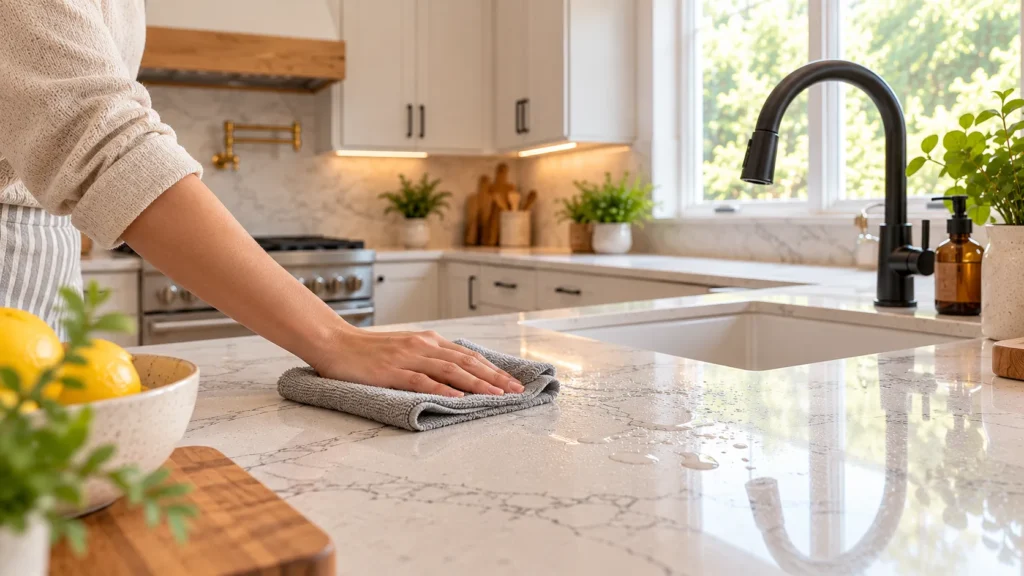
Your intended application can influence which finish makes the most sense.
Kitchen Islands
Kitchen islands are often central to food preparation, entertaining, and family activities. They are also highly visible design features.
Matte quartz may suit an island intended to create a subtle, contemporary focal point. Polished quartz may be a better fit when the island is designed to brighten the room or showcase a distinctive pattern.
Consider how frequently the island will be used, whether it receives direct sunlight, and how much maintenance you are comfortable performing.
Bathroom Vanities
Bathroom vanities are exposed to water, soap, cosmetics, toothpaste, and personal-care products.
Both finishes can work well, but the countertop should be selected according to the manufacturer’s guidance for bathroom use and cleaning.
Polished quartz can provide a clean, refined appearance, while matte quartz can complement contemporary bathroom designs with natural wood, neutral tiles, and brushed fixtures.
Regardless of the finish, wipe away standing water and product residue to reduce the likelihood of visible deposits.
For additional design inspiration, explore Cava Granite’s other countertop and surface products and discuss the most suitable product for your vanity project.
Laundry Rooms and Secondary Workspaces
Quartz can also be considered for laundry rooms, home bars, and other interior workspaces, provided the selected product is appropriate for the intended application.
In these spaces, the finish may be chosen primarily for design consistency with adjacent rooms.
A matte surface can blend into a restrained interior, while polished quartz can provide a brighter, more decorative finish.
8. Common Myths About Matte and Polished Quartz Countertops
Misunderstandings about countertop finishes can lead homeowners to make decisions based on assumptions rather than product specifications.
Myth 1: Matte Quartz Is Always More Scratch-Resistant
Reality: Scratch resistance depends on the particular quartz product and its construction. A matte finish may make some minor marks less noticeable, but that does not establish that the surface is inherently more scratch-resistant.
Myth 2: Polished Quartz Never Shows Stains
Reality: Engineered quartz is generally non-porous and stain-resistant, but it is not immune to every type of staining or chemical damage. Residue, mineral deposits, and unsuitable cleaning products can affect its appearance.
Myth 3: Matte Quartz Does Not Show Fingerprints
Reality: Matte finishes may reduce the visibility of certain smudges, but oily fingerprints can still appear. Colour, texture, lighting, and the specific product all influence the result.
Myth 4: Polished Quartz Is Always Cheaper
Reality: Pricing varies by manufacturer, colour, design, finish availability, and fabrication requirements. Request a quotation for the exact products you are considering.
Myth 5: Quartz Can Handle Any Amount of Heat
Reality: Quartz is heat-resistant to a degree, but excessive or sudden heat can damage the resin and cause discolouration or cracking. Use trivets or heat-resistant pads rather than placing hot cookware directly on the countertop.
Myth 6: Every Quartz Finish Has the Same Cleaning Requirements
Reality: General care practices are similar, but manufacturers may recommend different cleaning methods for polished, matte, honed, or textured finishes. Always follow the product-specific instructions.
9. How to Choose the Right Quartz Finish for Your Home
Before finalizing your countertop selection, evaluate the practical and visual factors that matter most to your household.
Step 1: Decide on Your Preferred Appearance
Determine whether you want a glossy, reflective surface or a subtle, low-sheen finish.
Look at photographs in the Cava Granite countertop gallery for inspiration, but remember that online images may not accurately reproduce the colour, texture, or reflectivity of a real quartz slab.
Step 2: Consider Your Kitchen Lighting
Natural light, pendant lights, recessed lighting, and under-cabinet fixtures can all influence how a countertop looks.
A polished surface may create noticeable reflections in a brightly lit kitchen. A matte surface may produce a more restrained effect.
Inspect samples under lighting that resembles your actual kitchen.
Step 3: Match the Countertop to Your Cabinets
Bring cabinet, flooring, and backsplash samples when evaluating quartz options.
This helps you compare undertones and determine whether the countertop creates the contrast or visual continuity you want.
Step 4: Evaluate Your Cleaning Preferences
Consider whether you prefer the ease of wiping a smooth, polished surface or the softer appearance of a matte finish.
Ask the supplier to demonstrate the recommended cleaning process and explain whether the particular product has any special maintenance requirements.
Step 5: Check the Product Specifications
Confirm the manufacturer’s guidance on durability, heat exposure, cleaning products, warranty coverage, and approved applications.
Do not rely exclusively on general comparisons between matte and polished finishes.
Step 6: Request a Detailed Installation Estimate
Make sure the quotation reflects your actual project, including measurements, cutouts, edge profiles, backsplash details, fabrication, and installation.
If you are renovating in Kitchener, Waterloo, Cambridge, or Guelph, working with a countertop specialist can help you coordinate material selection with the technical requirements of your kitchen.
10. Why Choose Cava Granite for Quartz Countertops in Kitchener?
Choosing a countertop involves more than selecting a colour or finish. Accurate measurements, appropriate slab selection, precise fabrication, and professional installation all contribute to the finished result. Reviewing customer testimonials about Cava Granite can also help homeowners learn about other customers’ experiences.
Cava Granite supplies, fabricates, and installs quartz countertops for residential and commercial projects in Kitchener, Waterloo, Cambridge, and Guelph. The company helps homeowners explore available materials and coordinate countertop selections with their cabinetry, backsplash, edge profiles, and overall design.
Whether you prefer the understated appearance of matte quartz or the reflective elegance of polished quartz, the goal is to select a product that meets your visual preferences and practical requirements.
What to Consider Before Your Consultation
Before contacting a countertop supplier, it helps to prepare:
- Approximate countertop dimensions or a kitchen layout.
- Photographs of your existing kitchen or renovation plans.
- Preferred quartz colours and patterns.
- Cabinet and backsplash colours.
- Your preferred finish: matte, polished, or an alternative offered by the manufacturer.
- Details about sink type, cooktop openings, and island dimensions.
- An approximate project budget and timeline.
These details make it easier to discuss suitable materials and obtain a more relevant project estimate.
To learn more about available materials and installation services, visit Cava Granite’s quartz countertop page or explore its countertops in Kitchener service page.
Homeowners can also contact Cava Granite to discuss their project and arrange a consultation.
Frequently Asked Questions About Matte vs Polished Quartz Countertops
Is matte or polished quartz better for kitchen countertops?
Neither finish is universally better. Matte quartz is ideal for homeowners who prefer a soft, low-sheen appearance, while polished quartz suits those who want a glossy surface that reflects light. Consider maintenance preferences, lighting, colour, and product specifications before deciding.
Does matte quartz cost more than polished quartz?
Not necessarily. The price depends on the manufacturer, quartz design, finish availability, slab requirements, and fabrication details. Request quotes for comparable products to determine whether a particular finish carries an additional cost.
Which quartz finish hides fingerprints better?
Matte quartz may disguise some fingerprints because it produces less reflection. However, oily marks can still appear, particularly on dark or uniform surfaces. The specific product and colour influence the result.
Is polished quartz easier to clean than matte quartz?
Polished quartz is often easier to wipe clean because of its smooth surface. Certain matte or honed finishes can require additional attention to remove residue and metal marks. Follow the manufacturer’s cleaning instructions for the exact product.
Does matte quartz scratch more easily than polished quartz?
The finish alone does not determine scratch resistance. Both options can be durable, but their performance depends on the specific quartz product. Matte surfaces may disguise some minor marks, whereas fine scratches on polished surfaces may catch reflected light.
Does matte quartz need to be sealed?
Most engineered quartz countertops, including many matte products, do not require routine sealing. Confirm the manufacturer’s instructions for your specific surface before applying any sealer or other treatment.
Is matte quartz suitable for a busy family kitchen?
Yes, provided the selected product meets your needs and you follow the recommended care instructions. Matte quartz can create an attractive, understated kitchen surface, but it may show certain residues or marks depending on the colour and texture.
Is polished quartz a good choice for a small kitchen?
Polished quartz can help reflect available light, which may make a small kitchen feel brighter. Light-coloured matte quartz can also work well. Cabinet colours, lighting, and the overall design are just as important as the finish.
Can matte and polished quartz be used in the same kitchen?
Yes, if the selected products are compatible and the design is coordinated carefully. For example, contrasting finishes may help distinguish an island from the surrounding countertops. Confirm colour consistency, finish availability, and fabrication requirements before proceeding.
Which quartz finish is best for homes in Kitchener, Ontario?
The best finish depends on your home’s design, lighting, household routines, and budget. Homeowners in Kitchener can compare both finishes through local countertop suppliers and review samples before making a final selection.
Matte vs Polished Quartz Countertops
When comparing matte vs polished quartz countertops, the right choice comes down to the balance between appearance, maintenance, and your preferred interior style.
Matte quartz is an excellent option for homeowners who appreciate a contemporary, understated aesthetic with minimal surface glare. Polished quartz is ideal for those who prefer a glossy finish that reflects light and emphasizes colours and patterns.
Both can provide attractive, durable, low-maintenance countertop surfaces when the right product is selected and properly cared for.
Before making your final decision, compare real samples, review manufacturer care instructions, and evaluate how each finish looks alongside your cabinets, backsplash, and lighting.
If you are planning a kitchen renovation in Kitchener, Waterloo, Cambridge, or Guelph, Cava Granite can help you explore quartz countertop options and plan a custom installation suited to your space.
Ready to choose your quartz countertop finish? Contact Cava Granite to explore available countertop options, discuss your renovation requirements, and request a project estimate.