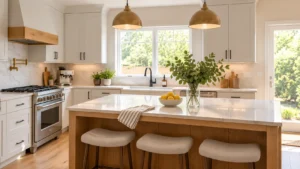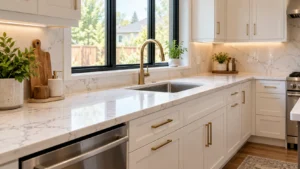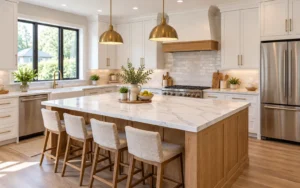
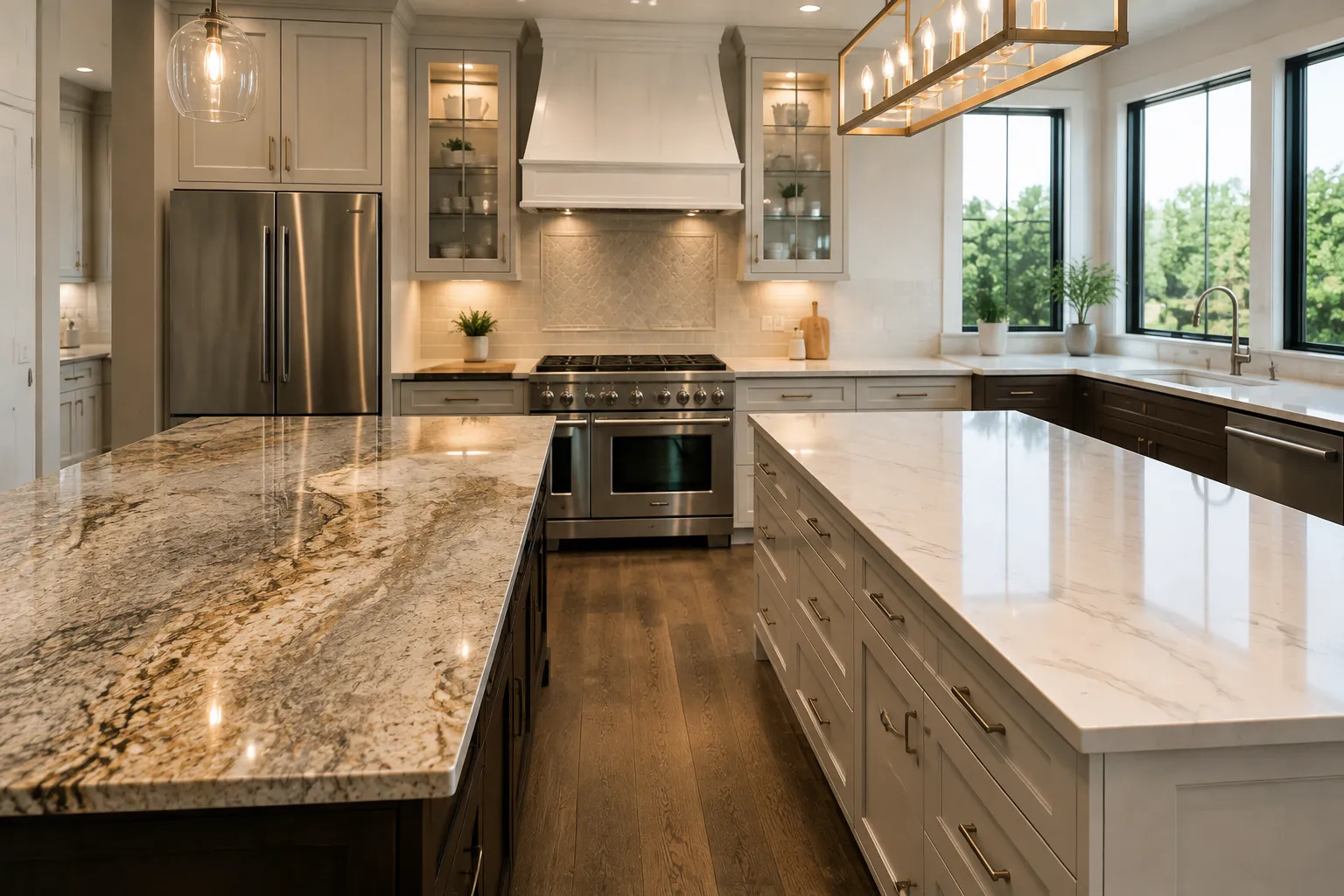
Choosing between granite and quartz often starts with one question: granite vs quartz cost—but the cheapest quote is not necessarily the best value. Your final countertop budget depends on the material, slab selection, kitchen layout, edge profile, cutouts, installation, and other project requirements.
For homeowners in Kitchener, Waterloo, Cambridge, Guelph, and surrounding Ontario communities, the granite vs quartz cost decision is especially important because two visually similar countertops can have very different maintenance requirements and installation considerations.
This guide breaks down the granite vs quartz cost question from the initial material price through installation and long-term ownership. You will also learn when granite may make more sense, when quartz is worth paying for, and how to compare quotes without overlooking hidden costs.
Granite vs Quartz Cost
Granite vs quartz cost can be surprisingly close because both materials span multiple price levels. The final price depends more on slab selection, fabrication, countertop size, edge details, cutouts, installation and project complexity than on the material name alone. For an accurate comparison, request itemized quotes for both options using the same measurements and specifications.
Granite vs Quartz Cost at a Glance
| Cost factor | Granite | Quartz |
| Material pricing | Varies widely by slab | Varies by brand, colour and collection |
| Installation | Depends on project complexity | Depends on project complexity |
| Maintenance | May require sealing depending on stone | Generally very low maintenance |
| Appearance | Unique natural patterns | Consistent engineered designs available |
| Heat considerations | Generally strong heat resistance | Use trivets for hot cookware |
| Long-term upkeep | Potential sealing and care | Minimal routine maintenance |
| Best for | Natural-stone character and heat performance | Low maintenance and design consistency |
The key point is simple: granite vs quartz cost should be evaluated as a complete installed project, not just a price per square foot.
What Determines Granite vs Quartz Cost?

The material itself is only one part of the quote. Several factors can move your final price substantially.
1. Countertop Size
A larger kitchen requires more material and may require additional slabs. Islands can also increase material usage because of their depth and overhang.
When comparing granite vs quartz cost, measure the actual countertop area rather than relying on a generic kitchen-size estimate.
2. Slab Selection
Not all granite slabs cost the same, and Quartz collections such as Mars Quartz also occupy different price levels. .
A basic granite colour may fit a tighter kitchen countertop budget, while an exotic granite slab with unique natural patterns can cost significantly more.. Likewise, premium quartz with intricate veining or specialized finishes can increase the project price.
This is one reason a simple statement such as “granite is cheaper” or “quartz is more expensive” is unreliable.
3. Edge Profiles
A standard edge is usually simpler than a highly decorative profile.
If your design includes a detailed edge, ask whether fabrication is included in the quote. The same principle applies when comparing granite vs quartz cost: compare identical specifications.
4. Sink and Cooktop Cutouts
Sink, cooktop and other custom cutouts require fabrication work. Their number and complexity can affect the final quotation.
An undermount sink may also require a different finishing approach than a basic drop-in installation.
5. Backsplashes and Full-Height Panels
A countertop project may include more than the horizontal surface, including outdoor applications such as BBQ countertops for outdoor places.
If you want the stone to continue up the wall with granite and quartz backsplashes or behind a range, additional material and fabrication can change the total project cost.
6. Installation and Site Conditions
Kitchen layouts are rarely identical.
Corners, seams, islands, walls that are not perfectly square, difficult access, demolition and existing cabinetry conditions can all affect installation requirements.
That means a realistic granite vs quartz cost comparison should always include fabrication and installation—not simply the slab price.
Granite vs Quartz Cost: Which Is Cheaper?

There is no universal answer.
Granite and quartz both have entry-level, mid-range and premium options. A particular granite slab can be less expensive than a particular quartz design, while another granite slab can cost considerably more.
Industry pricing guides also commonly group quartz and natural stone such as granite in similar broad installation price categories rather than treating one as universally cheaper.
So instead of asking only, “Which countertop costs less?” ask:
- Which material fits my design?
- Which slab is being quoted?
- What fabrication is included?
- Is installation included?
- Are sink and cooktop cutouts included?
- Are edges included?
- Are backsplash pieces included?
- Are removal and disposal included?
- Are taxes included?
This approach gives you a much more useful granite vs quartz cost comparison.
Granite vs Quartz Cost Per Square Foot: Why Quotes Differ
Homeowners often search for a single per-square-foot number. The problem is that a countertop is a custom-fabricated product.
Two kitchens with the same countertop area can have different prices because one has:
- A large island
- Multiple corners
- More seams
- Several sink cutouts
- A premium edge
- A full-height backsplash
- Difficult installation access
The other may have a straightforward rectangular layout.
For that reason, granite vs quartz cost should be treated as a project estimate rather than a universal retail price.
A professional countertop company can measure your space, discuss slab options and provide expert countertop installation based on your actual design.
Granite vs Quartz Cost and Long-Term Maintenance
The initial quotation is only part of the ownership equation.
Granite Maintenance
Granite is natural stone, and its characteristics vary by stone. Proper care depends on the specific material.
The Natural Stone Institute recommends understanding the geological classification and characteristics of your stone before choosing cleaning products and maintenance practices.
Some granite surfaces may benefit from periodic sealing, while maintenance requirements depend on the particular stone and sealer used.
That means maintenance should be considered when evaluating granite vs quartz cost over the life of the countertop.
Quartz Maintenance
Quartz is engineered rather than a single natural slab of quarried stone. Its nonporous construction makes routine maintenance relatively simple.
For example, Caesarstone Canada states that its quartz surfaces do not require sealing and recommends avoiding harsh chemicals, abrasive cleaners and direct contact with very hot cookware.
That low-maintenance characteristic can make quartz attractive to busy households.
However, low maintenance does not mean indestructible. Quartz manufacturers still recommend using trivets and cutting boards to protect the surface from heat and scratches.
Granite vs Quartz Cost: Which Has Better Value?
The answer depends on what you value.
If your priority is low maintenance, quartz may provide excellent everyday value.
If your priority is natural stone character, granite can offer something manufactured surfaces cannot perfectly reproduce: a naturally formed slab with its own pattern and variation.
If your kitchen receives significant heat exposure, granite may also deserve serious consideration. Quartz is durable, but manufacturers recommend protecting it from very hot cookware.
Therefore, the best granite vs quartz cost decision is not necessarily the lowest upfront quote. It is the material that gives you the combination of appearance, performance, maintenance and budget you actually want.
A Better Way to Compare Granite vs Quartz Cost

Before choosing a countertop, use this five-step process.
Step 1: Set Your Total Budget
Determine the maximum amount you are comfortable spending on the complete countertop project.
Do not allocate the entire budget to the slab.
Leave room for:
- Fabrication
- Installation
- Cutouts
- Edge finishing
- Backsplash
- Demolition
- Plumbing-related adjustments
- Taxes and other applicable project costs
Step 2: Choose Your Must-Have Features
Decide what matters most.
For example:
If you prioritize low maintenance:
Quartz may be attractive.
If you prioritize natural variation:
Granite deserves a closer look.
If you want a specific colour:
Compare actual slabs rather than comparing material categories.
If you cook frequently:
Discuss heat exposure and care requirements with your countertop professional.
Step 3: Compare Actual Slabs
Do not compare “granite” against “quartz” as abstract categories.
Compare the exact granite slab with the exact quartz colour or collection you are considering.
This creates a meaningful granite vs quartz cost comparison.
Step 4: Request an Itemized Quote
A useful quotation should make it clear what is included.
Ask for:
- Material
- Measurement
- Fabrication
- Edge profile
- Sink cutout
- Cooktop cutout
- Installation
- Backsplash
- Removal
- Taxes or other applicable charges
Step 5: Compare Value, Not Just Price
Suppose quartz costs somewhat more for your selected design.
If the quartz eliminates sealing and gives you the appearance and maintenance profile you prefer, the difference may be worthwhile.
On the other hand, if a granite slab provides the exact look you want at a lower installed price, there may be little reason to pay more simply because quartz is popular.
A Practical Kitchener Example
Imagine a homeowner renovating a kitchen in Kitchener with a medium-sized countertop and a large island.
They receive two quotes.
Option A: Granite
- Natural stone
- Unique slab pattern
- Standard edge
- Sink and cooktop cutouts
- Professional installation
Option B: Quartz
- Engineered stone
- Consistent pattern
- Similar edge
- Same cutouts
- Professional installation
If the two installed quotes are close, the homeowner should not choose purely based on price.
Instead, consider:
- Which slab looks better with the cabinets?
- Which surface fits the household’s cooking habits?
- How much maintenance is acceptable?
- How important is natural variation?
- How will heat exposure be managed?
- Which warranty and installation terms are offered?
That is the practical way to evaluate granite vs quartz cost.
When Granite May Be the Better Choice
Granite may make sense if you:
- Prefer authentic natural stone
- Want every slab to have individual character
- Like natural colour variation
- Want strong heat resistance
- Are comfortable with appropriate stone maintenance
- Find a particular granite slab that fits your budget exceptionally well
Cava Granite describes its granite selection as natural stone with individual colours, veining and character, and provides fabrication and installation in Kitchener, Waterloo, Cambridge, Guelph and surrounding communities.
When Quartz May Be the Better Choice

Quartz may be a strong choice if you:
- Prefer consistent design, including premium marble-look options such as Taj Mahal countertops
- Want low routine maintenance
- Like modern marble-look patterns
- Want a nonporous surface
- Prefer not to deal with sealing
- Want a wide range of contemporary colours and designs
Cava Granite offers quartz countertops for homeowners in Kitchener and Waterloo and describes quartz as an engineered countertop material designed for durability and low maintenance.
Common Mistakes When Comparing Granite vs Quartz Cost
Mistake 1: Choosing the Cheapest Slab
The cheapest material may not deliver the appearance or performance you want.
Mistake 2: Comparing Different Specifications
A quote with a standard edge should not be compared directly with another quote containing a premium edge and additional backsplash.
Mistake 3: Ignoring Installation
Fabrication and installation are major parts of a custom countertop project.
Mistake 4: Assuming Quartz Needs No Protection
Quartz is low maintenance, but it still requires sensible care. Manufacturers recommend trivets for hot cookware and cutting boards for food preparation.
Mistake 5: Choosing From Photos Alone
Natural stone can look very different in person. If possible, inspect the actual slab before making a final decision.
How to Get the Best Countertop Value in Kitchener
For homeowners comparing granite vs quartz cost in Kitchener, Waterloo, Cambridge or Guelph, start with the complete project rather than a material-only price.
Cava Granite operates from 1358 Victoria St N, Kitchener, ON N2B 3E2 and provides countertop services across the Waterloo Region and surrounding communities.
A useful next step is to bring your kitchen measurements, cabinet plans or renovation drawings to a countertop professional. Discuss your preferred colours, edge style, sink type and budget before selecting a slab.
Looking for a practical countertop estimate? Compare your preferred granite and quartz options based on the same measurements and specifications so you can see the real difference rather than guessing from generic online prices.
Granite vs Quartz Cost: Final Verdict
There is no single winner in the granite vs quartz cost debate.
Granite can be an excellent value when you want natural stone, unique patterns and strong heat performance. Quartz can be an excellent value when you want consistent designs, low maintenance and a nonporous surface.
The smartest choice is to compare the installed project cost, not just the material price.
For a Kitchener-area renovation, ask for an itemized quote for both materials using the same countertop measurements, edge profile, cutouts and installation requirements. Then choose the surface that gives you the best combination of appearance, performance, maintenance and budget.
Cava Granite provides custom granite and quartz countertop fabrication and professional countertop installation for homeowners throughout Kitchener, Waterloo, Cambridge, Guelph and surrounding areas.
Ready to compare your options? Contact Cava Granite for a consultation and discuss your project, preferred material and countertop budget before making a final decision.
Frequently Asked Questions
Is granite cheaper than quartz?
Granite is not always cheaper than quartz. Both materials have different price levels, and the final installed cost depends on the slab, fabrication, countertop size, cutouts, edges, backsplash and installation requirements.
Which is better for a kitchen, granite or quartz?
It depends on your priorities. Quartz is attractive for homeowners who want low maintenance and consistent designs, while granite is appealing to homeowners who prefer natural stone character and strong heat resistance.
Does quartz require sealing?
Quartz generally does not require sealing. For example, Caesarstone Canada states that its quartz surfaces are nonporous and do not need sealing.
Does granite require more maintenance than quartz?
Generally, granite requires more maintenance consideration than quartz, because some natural stone surfaces may require sealing and specific cleaning practices. The exact requirements depend on the granite and its finish.
Can quartz be damaged by hot pans?
Yes. Quartz is heat resistant, but manufacturers recommend using trivets or heat pads instead of placing very hot cookware directly on the surface.
How can I get an accurate countertop price?
Request an itemized quote based on your actual kitchen measurements. Ask the countertop company to specify material, fabrication, edge profile, cutouts, installation, backsplash, removal and other applicable charges.