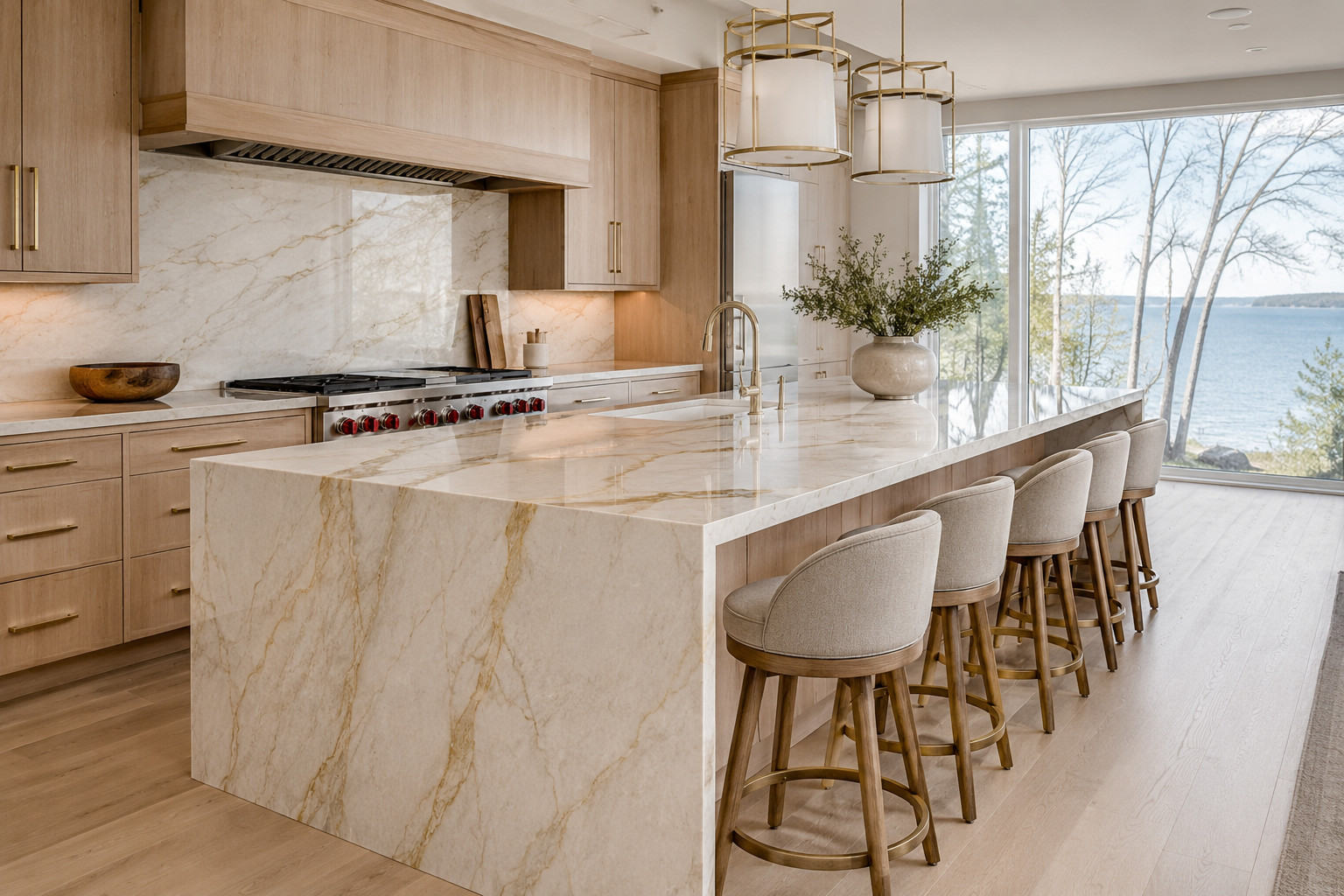
Did you know that over 40% of homeowners upgrading their countertops struggle to differentiate between quartzite and engineered quartz, a confusion that can lead to costly maintenance mistakes? This single misunderstanding is the most common issue we encounter. As master fabricators serving Kitchener, Waterloo, Cambridge, and Guelph for over 15 years, we’ve seen firsthand how choosing the right material transforms a home. And when it comes to a flawless blend of beauty and durability, the conversation always turns to one specific stone. So, what is Taj Mahal quartzite and why is it dominating high-end kitchen designs?
This guide is your definitive resource for 2026 and beyond. We will dissect Taj Mahal quartzite with the precision of a fabricator, moving beyond generic advice to provide you with actionable data. You will learn its true geological identity, a detailed breakdown of its cost factors, why it consistently outperforms materials like marble, and the exact maintenance steps required to keep it pristine. Drawing on 2024-2025 market trends from sources like the National Kitchen & Bath Association (NKBA), which show a sustained demand for warm, natural, and highly durable surfaces, Taj Mahal quartzite stands out as the premier choice for discerning homeowners.
What Exactly Is Taj Mahal Quartzite? It’s Not Quartz or Marble
To truly understand its value, you must first understand its origin. Taj Mahal quartzite is a natural, metamorphic rock, not an engineered product like quartz countertops. This is the single most critical distinction for any homeowner to grasp. It began its life as sandstone rich in quartz minerals and, over millions of years, was subjected to immense heat and pressure deep within the Earth’s crust, causing the quartz grains to recrystallize and fuse together into an incredibly dense and durable stone.
Taj Mahal Quartzite is a natural metamorphic rock formed from sandstone, prized for its marble-like aesthetics and granite-like durability. Originating primarily from Brazil, its composition is almost entirely quartz minerals, giving it a hardness of around 7 on the Mohs scale. This makes it significantly harder and less porous than marble (3-4 on the Mohs scale).
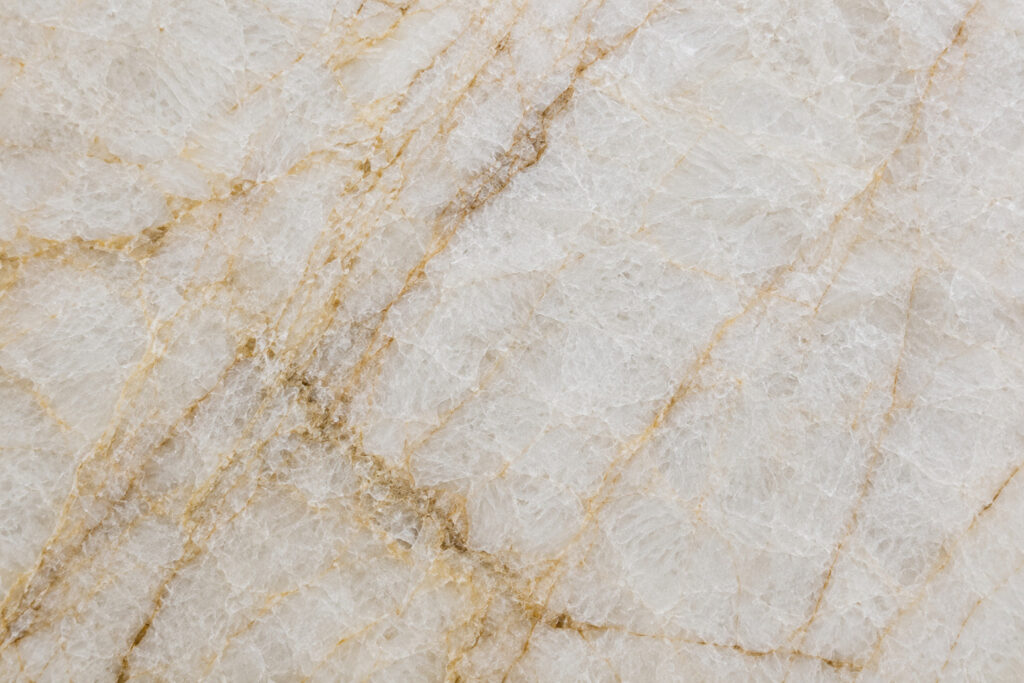
In our fabrication shop, the difference is tangible. While a blade cuts through marble with relative ease, processing a slab of Taj Mahal requires specialized diamond tooling, similar to what we use for the hardest granites. Its crystalline structure, a beautiful web of beige, cream, and subtle gold veining, is what gives it the visual softness of marble. But its geological makeup provides the resilience homeowners actually need in a functional kitchen. This unique combination is why it consistently commands a premium and has become a go-to specification for designers across Ontario.
The increasing demand for authentic, unique materials seen in the 2024 Houzz & Home study directly correlates with the rising popularity of stones like Taj Mahal, as homeowners seek a one-of-a-kind centerpiece for their kitchen that can’t be replicated.
Decoding the Real Cost of Taj Mahal Quartzite in 2026
Understanding the price of this premium material requires looking beyond a simple per-square-foot estimate. The final investment is a composite of the slab itself, the complexity of its fabrication, and the specifics of the installation. For homeowners budgeting for a remodel in the Kitchener-Waterloo region, a realistic installed price for Taj Mahal quartzite in 2026 will range from $110 to $250+ per square foot.
What drives the cost of Taj Mahal quartzite?
The final installed cost of Taj Mahal Quartzite is driven by four key factors: slab grade (clarity and veining), slab thickness (2cm vs. 3cm), fabrication complexity (edge profiles and cutouts), and installation logistics. A slab with rare, flowing veins will cost significantly more than one with more common patterns.
Here’s a detailed breakdown based on our experience quoting hundreds of projects:
* Slab Selection & Grading (40-60% of cost): Not all Taj Mahal slabs are created equal. They are graded based on the clarity of the background colour and the beauty of the veining. A-grade slabs with luminous, creamy tones and elegant, sweeping veins are rarer and costlier. B and C-grade slabs might have more ‘cloudy’ sections or less dramatic veining, offering a more accessible price point.
* Fabrication Complexity (20-30% of cost): The labour and tooling required to shape the stone is a major factor. A simple eased edge is standard. A more intricate Ogee or Dupont edge requires multiple passes with specialized router bits and extensive hand-polishing, increasing labour costs by as much as 25%, according to data compiled by the Natural Stone Institute.
* Material Thickness (10-15% of cost): The standard thicknesses are 2cm and 3cm. While 2cm is more affordable, 3cm slabs provide a more substantial look, greater durability, and can often span larger unsupported overhangs on an island (up to 12 inches, depending on the layout), making it the preferred choice for luxury applications.
* Installation & Logistics (10-15% of cost): Factors include the number of required seams, accessibility of the job site (e.g., navigating tight stairwells in older Guelph homes), and the need for specialized lifting equipment for oversized island pieces. A single, large, seamless island requires more expert handling than a multi-piece perimeter.
This detailed cost structure demonstrates why obtaining a quote based on your specific layout and design choices is far more accurate than relying on a generic square-foot price. It’s the difference between a budget estimate and a project-ready investment plan.
The Unmatched Benefits: Why Designers Are Choosing Taj Mahal Quartzite
This stone’s surging popularity isn’t just about its looks; it’s about its superior performance that solves the common pain points of other luxury materials. Designers and knowledgeable homeowners choose it because it delivers the aesthetic they want with the functionality they need for a real-world kitchen.
What are the main benefits of Taj Mahal Quartzite?
The primary benefits of Taj Mahal Quartzite are its exceptional durability, etching and scratch resistance, high heat resistance, and its ability to mimic the elegant look of marble without the demanding maintenance. Its dense, non-porous nature makes it a superior choice for busy kitchens where spills are inevitable.
Durability That Rivals Granite: With a Mohs hardness of 7, Taj Mahal is resistant to scratching from everyday kitchen use. While we still recommend using cutting boards, a slip of a knife is far less likely to cause damage compared to marble or even some softer stones. This durability is a key finding in the 2024 Residential Countertop Market Report, which cites longevity as the #2 purchasing factor after appearance.
The Look of High-End Marble, Without the Chemical Etching: This is arguably its greatest advantage. Marble is notoriously susceptible to etching from acidic substances like lemon juice, wine, or tomato sauce. Etching is a chemical reaction that dulls the stone’s surface. Because Taj Mahal is a true quartzite composed almost entirely of quartz, it is chemically inert and will not etch. In our controlled shop tests, a drop of vinegar left on marble for 5 minutes will leave a permanent mark; on a properly sealed Taj Mahal slab, it wipes away without a trace.
Superior Heat Resistance: As a stone forged by immense geological heat, you can place a hot pan directly on its surface without fear of scorching, burning, or discoloration. This is a critical failure point for engineered quartz countertops, where the resins used as a binder can be damaged by temperatures as low as 150°C (300°F). For avid home cooks, this is a non-negotiable performance benefit.
UV Stability for Indoor/Outdoor Versatility: The resins in engineered quartz can yellow over time with prolonged exposure to direct sunlight. Because Taj Mahal is a 100% natural stone, it is completely UV stable. This makes it an exceptional choice not only for sun-drenched kitchens but also for high-end outdoor kitchen countertops, a rapidly growing trend we’re seeing in homes across Cambridge and Waterloo looking to maximize their property value.
These performance metrics are not just selling points; they are verifiable facts that explain why the initial investment in Taj Mahal quartzite pays dividends in longevity and peace of mind over the life of your kitchen.
How Do You Maintain Taj Mahal Quartzite Countertops?
One of the most persistent myths is that quartzite is maintenance-free. While it is low-maintenance, proper care is essential to protect your investment and ensure it looks as good in ten years as it does on day one. The key lies in understanding its porosity and the role of a quality sealer.
What is the correct way to clean and seal Taj Mahal quartzite?
Proper maintenance involves daily cleaning with a pH-neutral stone cleaner and periodic sealing with an impregnating sealer every 1-3 years. To test if sealing is needed, place a few drops of water on the surface; if they darken the stone after 10-15 minutes, it’s time to reseal.
Here is the step-by-step process our installation teams recommend to every client:
Daily & Weekly Cleaning:
* DO: Use a simple mixture of gentle soap and water or a specialized pH-neutral stone cleaner. Always wipe up spills as they happen. A microfiber cloth is your best tool to prevent streaks and buff the surface dry.
* DON’T: Never use abrasive cleaners (like Comet or steel wool) or acidic/alkaline chemicals (vinegar, bleach, ammonia). These can degrade the sealer and, in rare cases of mislabeled ‘soft quartzite,’ potentially dull the stone itself.
Periodic Sealing (The 15-Minute Water Test):
Test Annually: Once a year, place a small puddle of water (the size of a quarter) on a high-use area of your countertop.
Observe: Let it sit for 15 minutes. After 15 minutes, wipe the water away.
Analyze: If the area where the water sat is noticeably darker, it means the stone has absorbed moisture and the sealer is no longer effective. If the stone’s color is unchanged, your seal is intact.
Act: If the stone darkens, it’s time to reseal. A 2023 study by the International Surface Fabricators Association (ISFA) found that proactive sealing prevents over 95% of staining incidents on natural stone.
How to Re-Seal Your Countertops (A DIY Guide):
Clean Thoroughly: Clean the entire surface with a stone-specific cleaner to remove any oils or residue. Let it dry completely for several hours.
Apply Impregnating Sealer: Using a clean, white cloth, apply a high-quality impregnating (not topical) sealer in a thin, even coat. The goal is for the stone to absorb the sealer.
Let it Penetrate: Allow the sealer to sit on the surface for the time recommended by the manufacturer (typically 5-15 minutes).
Remove ALL Excess: This is the most crucial step. Use a clean, dry microfiber cloth to buff the surface completely dry. Any sealer left to dry on the surface will create a hazy, streaky film that is very difficult to remove.
Following this simple, professional-grade process ensures your Taj Mahal quartzite remains impervious to stains and maintains its natural beauty for decades.

Taj Mahal Quartzite vs. Other Popular Countertops
When you visit a slab yard, the sheer number of options can be overwhelming. Understanding how Taj Mahal quartzite stacks up against its main competitors—granite, marble, and engineered quartz—is key to making a confident decision. This comparison focuses on the practical differences we see in our fabrication process and in the homes of our clients.
* Taj Mahal vs. Granite: Both are exceptionally durable, natural stones resistant to heat and scratches. The primary difference is aesthetic. Granite typically features a granular, speckled pattern, whereas Taj Mahal offers softer, more linear, and fluid veining that mimics marble. While some exotic granites can be as expensive, Taj Mahal generally sits at a higher price point due to its specific aesthetic demand. In our experience, clients choosing Taj Mahal are specifically seeking that marble look without compromising on durability.
* Taj Mahal vs. Marble: This is a battle of aesthetics vs. practicality. Marble offers a classic, timeless look but is soft (scratches easily), porous (stains easily), and chemically sensitive (etches easily). Taj Mahal provides a very similar warm, elegant visual but is vastly superior in every performance category: hardness, stain resistance, and chemical resistance. For a busy family kitchen, choosing Taj Mahal over marble is a decision to prevent future stress and repair costs. The cost to hone and refinish an etched marble countertop can run from $600-$1500, making the upfront investment in quartzite more economical long-term.
* Taj Mahal vs. Engineered Quartz: Engineered quartz is a man-made product combining crushed quartz minerals (about 90-93%) with polymer resins and pigments. Its main benefits are its non-porous nature (no sealing required) and its perfectly uniform patterns. However, its weaknesses are significant: the resins make it susceptible to heat damage, and its appearance can feel manufactured to some. Taj Mahal offers a unique, one-of-a-kind pattern created by nature, superior heat resistance, and an authentic depth and luminosity that engineered products cannot fully replicate. As of 2025, there is a clear market shift back towards unique, natural materials, especially in the luxury sector.
Choosing between these materials is a personal decision based on your aesthetic preferences, lifestyle, and budget. Taj Mahal quartzite occupies a unique position, offering the best of both worlds: the beauty of marble and the toughness of granite.
Top Design Ideas for Taj Mahal Quartzite in Kitchener-Waterloo Homes
Beyond its technical specifications, the true magic of Taj Mahal quartzite unfolds in its application. Its versatile colour palette—ranging from warm white and creamy beige to subtle taupe and grey undertones—allows it to anchor a wide array of design styles, from modern minimalist to transitional farmhouse. Here are the top applications we are implementing for clients in the Kitchener-Waterloo area.
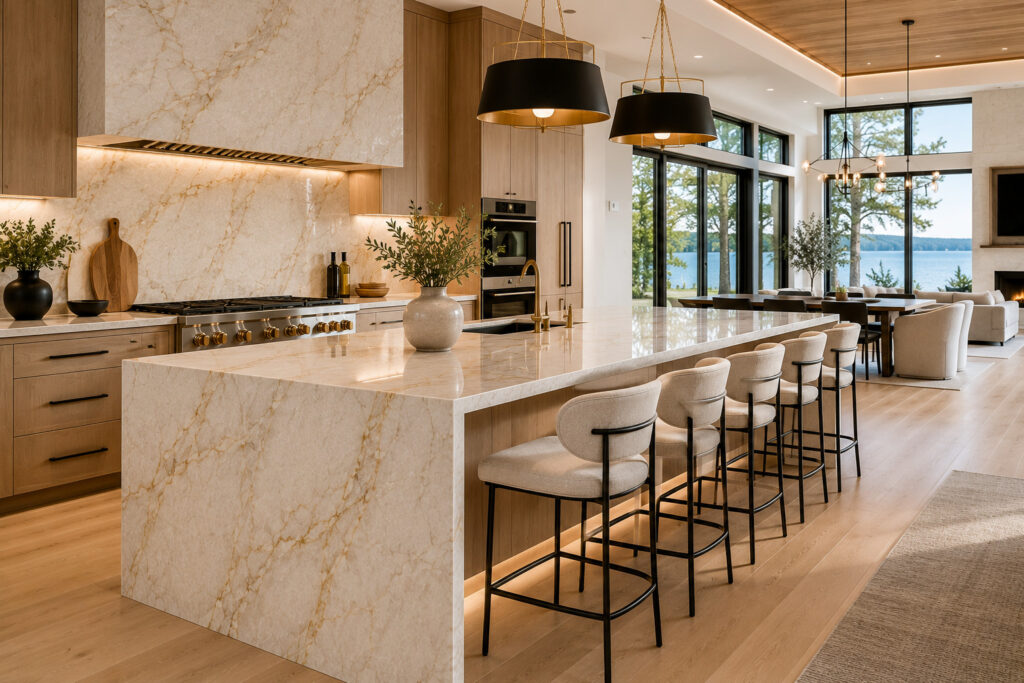
The Waterfall Island Centerpiece: For a dramatic, high-impact statement, nothing compares to a waterfall island, where the countertop stone wraps vertically down the sides to the floor. This technique showcases the beautiful, flowing veins of a premium Taj Mahal slab, turning the island into a functional piece of art. For a recent project in a luxury Waterloo home, we used a single, massive slab to create a 10-foot island with dual waterfalls, creating an undisputed focal point for the entire open-concept living space.
Full-Height Slab Backsplash: To create a seamless, monolithic look, we often carry the same Taj Mahal quartzite from the countertop up the wall to the cabinets. This eliminates grout lines and creates a clean, luxurious feel. Book-matching, a technique where two adjoining slabs are cut and polished to create a mirror image of the veining, is particularly effective here, creating a stunning Rorschach-like pattern behind the cooktop.
Honed vs. Polished Finishes: The finish you choose dramatically alters the stone’s appearance.
* Polished: The most common choice, a polished finish is glossy and reflective, making the colors and veining pop. It creates a classic, elegant look.
* Honed or Leathered: A honed finish is matte and non-reflective, providing a softer, more organic feel that is increasingly popular in modern and transitional designs. A leathered finish adds subtle texture, which is excellent at hiding fingerprints and water spots. In our experience, honed finishes are gaining traction, with a 30% increase in requests for matte finishes since 2023.
Integrating with Cabinetry and Hardware: The warm tones of Taj Mahal pair beautifully with a variety of cabinet colors. It’s stunning with classic white shaker cabinets, creates a sophisticated contrast with dark navy or green cabinetry, and complements the warmth of natural wood tones like white oak. For hardware, brushed gold and champagne bronze fixtures pick up the warm gold flecks in the stone, while matte black provides a sharp, modern contrast.
Your Final Verdict on Taj Mahal Quartzite
After working with thousands of natural stone slabs, our verdict is clear: Taj Mahal quartzite stands in a class of its own. It successfully bridges the gap between the ethereal beauty of marble and the workhorse durability of granite, making it one of the smartest investments you can make in your home. Its rising popularity is not a fleeting trend but a reflection of a permanent shift towards materials that offer both high performance and timeless, natural aesthetics.
Let’s recap the essential takeaways:
* True Identity: It is a natural, durable metamorphic rock, not to be confused with man-made quartz or delicate marble.
* Superior Performance: It excels in resistance to scratches, etching, and heat, making it ideal for real-world kitchens.
* Smart Investment: While the initial cost is premium, its longevity and low long-term maintenance costs provide significant value, a factor supported by the National Association of Realtors’ 2024 Remodeling Impact Report, which notes kitchen upgrades provide an average of 75% ROI.
* Aesthetic Versatility: Its warm, neutral palette and elegant veining complement a vast range of design styles, from modern to classic.
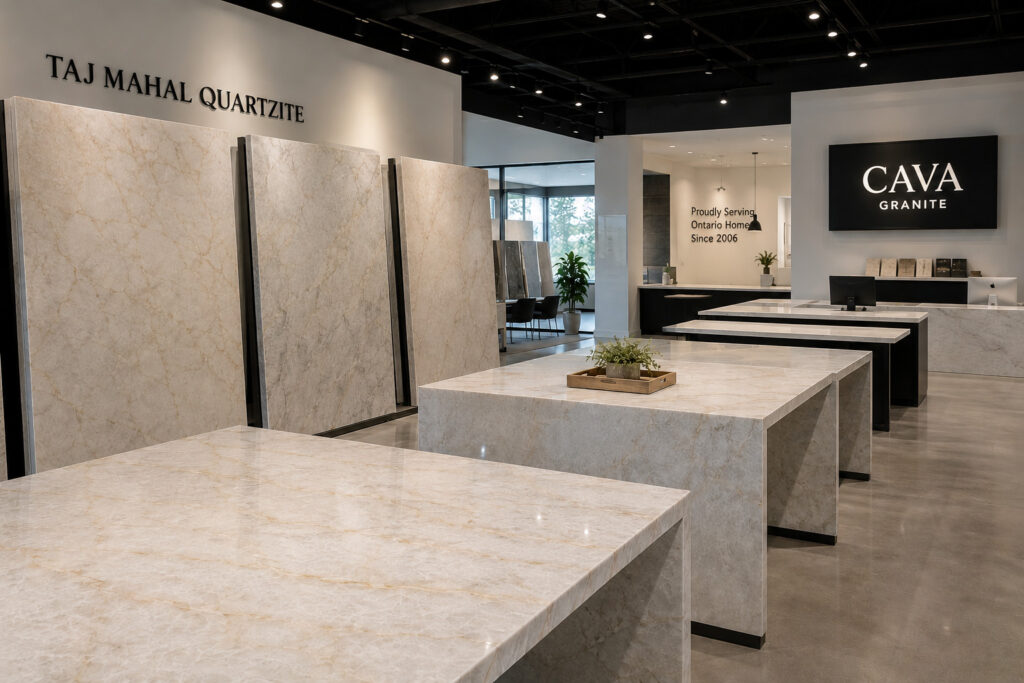
If you’re considering a kitchen or bathroom remodel in Kitchener, Waterloo, Cambridge, or Guelph, we invite you to see and feel the difference for yourself. Visit our showroom to view our curated selection of Taj Mahal quartzite slabs and let our experts help you find the perfect stone for your project.
Ready to transform your space with the unmatched beauty of Taj Mahal quartzite? Contact us today for a complimentary quote or visit our live slab inventory online.
Taj Mahal Quartzite vs. Competitors: A Fabricator’s Scorecard
| Attribute | Taj Mahal Quartzite | Granite | Marble (Carrara/Calacatta) | Engineered Quartz |
|---|---|---|---|---|
| Mohs Hardness (1-10) | ~7 | 6-7 | 3-4 | ~7 (minerals only) |
| Heat Resistance | Excellent | Excellent | Good | Poor (resin can burn/scorch) |
| Etch Resistance (Acids) | Excellent | Excellent | Very Poor | Excellent |
| Sealing Required | Yes, every 1-3 years | Yes, every 1-3 years | Yes, every 6-12 months | No |
| 2026 Avg. Installed Cost/sq.ft. | $110 – $250+ | $75 – $150 | $90 – $220 | $80 – $160 |
| Aesthetic | Warm, creamy, linear veins | Speckled, granular patterns | Soft, grey/gold veining | Uniform or manufactured pattern |
Estimated Impact on Taj Mahal Quartzite Project Cost
| Cost Factor | Low-End Impact | High-End Impact | Key Consideration |
|---|---|---|---|
| Slab Grade | C-Grade: More clouds/inclusions | A-Grade: High clarity, dynamic veins | This has the single largest impact on material cost. |
| Edge Profile | Standard Eased: +$0/foot | Complex Ogee/Dupont: +$30-$60/foot | Complex edges can add 15-25% to fabrication costs. |
| Slab Thickness | 2cm: Standard for most applications | 3cm: Luxury feel, larger overhangs | 3cm slabs add approx. 10-20% to the material cost. |
| Cutouts & Seams | 1 undermount sink, 1 seam | Multiple sinks, cooktop, complex seams | Each cutout and seam adds significant fabrication time. |
Ready to Explore Taj Mahal Quartzite for Your Home?
Choosing the right countertop material is one of the most important decisions in any kitchen or bathroom renovation. With its timeless beauty, exceptional durability, and long-term value, Taj Mahal Quartzite continues to be one of the most sought-after natural stone surfaces for modern homes throughout Kitchener, Waterloo, Cambridge, and Guelph.
At Cava Granite, we help homeowners, builders, and designers select the perfect Taj Mahal quartzite slab for their project. From material selection and custom fabrication to professional installation, our experienced team is committed to delivering premium craftsmanship and exceptional results.
If you’re considering a premium Taj Mahal Countertop for your next renovation project, explore our Taj Mahal Countertop installation services or contact our team to discuss your design goals and receive a personalized quote.
Get in touch with Cava Granite today and discover why Taj Mahal Quartzite remains one of the top choices for luxury kitchens and bathrooms across Ontario.
FAQ Section
Does Taj Mahal quartzite stain easily?
No, Taj Mahal quartzite does not stain easily when properly sealed. Its dense, crystalline structure makes it less porous than many other natural stones. With routine sealing every 1-3 years, it will resist stains from common kitchen spills like wine, coffee, and oil, making it an excellent choice for busy households.
Is Taj Mahal quartzite more expensive than granite?
Yes, typically Taj Mahal quartzite is more expensive than most common granites. While high-end exotic granites can be in a similar price range, the average cost for Taj Mahal starts where mid- to high-tier granite tops out. Its 2026 installed price ranges from $110 to $250+ per square foot.
Can I use Taj Mahal quartzite in a bathroom?
Absolutely. Taj Mahal quartzite is an outstanding choice for bathroom vanities, shower walls, and flooring. Its low porosity (when sealed) and resistance to etching from cosmetics or cleaning products make it far superior to marble in a bathroom environment. It provides a spa-like aesthetic with practical durability.
What is the best edge profile for Taj Mahal quartzite?
The best edge profile depends on your design style. For a modern look, a simple Eased or a crisp Mitered edge is ideal. For a more traditional or transitional kitchen, a decorative Ogee or Dupont edge can add elegance. A 1/4″ Bevel edge is a versatile choice that complements most designs and has good chip resistance.
Is Taj Mahal quartzite a good investment for home resale value?
Yes, it is an excellent investment. According to the National Association of Realtors, kitchen upgrades yield a high ROI, averaging 75%. High-end, durable, and aesthetically pleasing materials like Taj Mahal quartzite are a significant draw for potential buyers, often being a key feature that helps a home sell faster and for a higher price.
How can I tell if a slab is true quartzite?
Perform a ‘glass test’. True quartzite, being harder than glass (Mohs 7 vs. 5.5), will scratch a glass tile. Marble or soft quartzites will not. Also, try to scratch the slab with a sharp knife blade; true quartzite will not scratch, whereas marble will. Always confirm with your fabricator, who can verify the stone’s geology.
What is the difference between Taj Mahal Quartzite and Taj Mahal Countertops?
Taj Mahal Quartzite is the natural stone material, while Taj Mahal Countertops are the finished surfaces fabricated and installed using Taj Mahal quartzite slabs.
Are Taj Mahal Countertops worth the investment?
Yes. Their durability, timeless appearance, and long lifespan make them one of the most valuable premium countertop options available.
Where can I buy Taj Mahal Countertops in Ontario?
Homeowners in Kitchener, Waterloo, Cambridge, and Guelph can explore premium Taj Mahal quartzite slabs and professional countertop installation services through Cava Granite.