
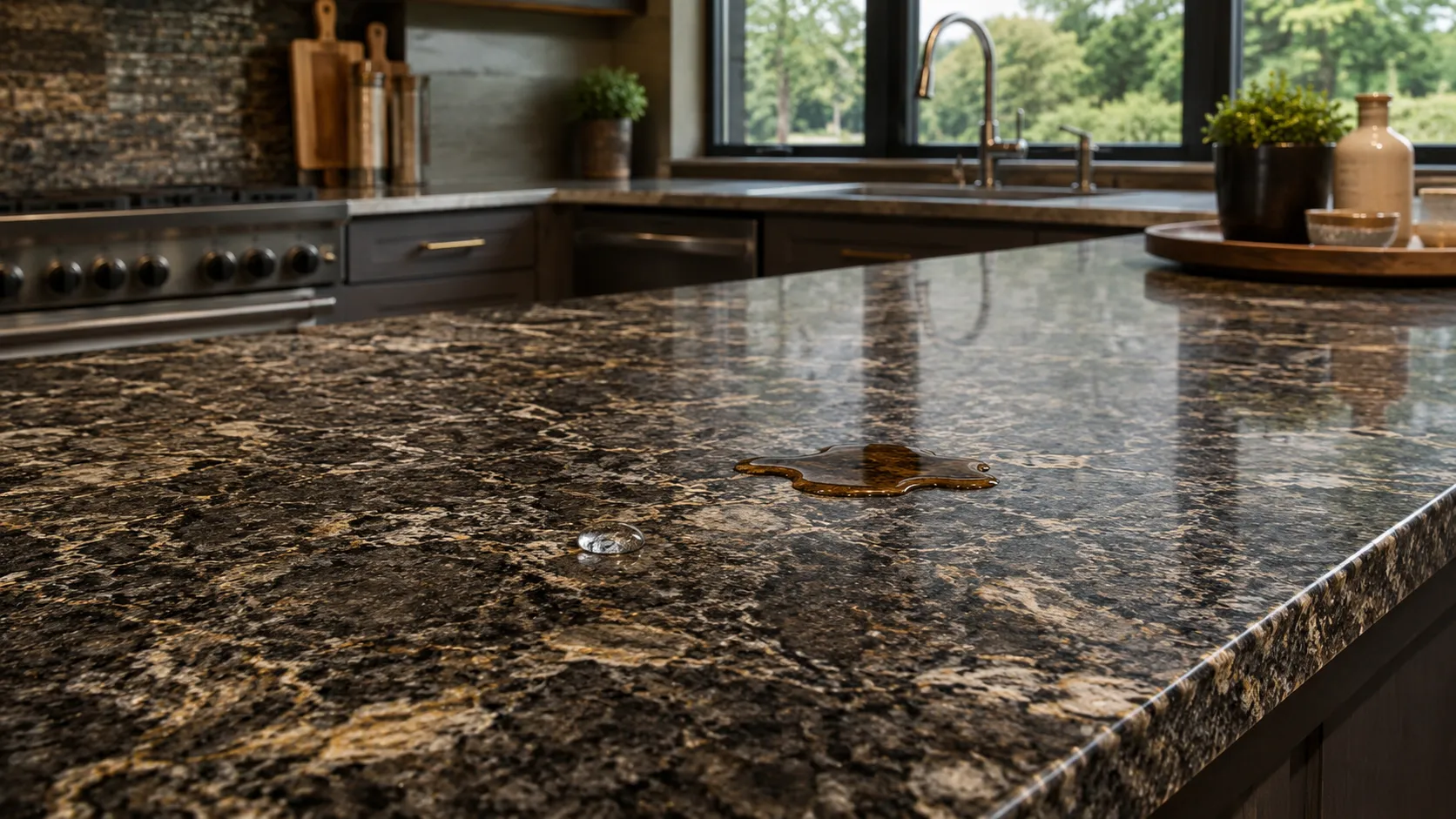
Granite is naturally durable, but durability does not mean it is completely resistant to staining. Kitchen spills, cooking oils, coffee, wine, acidic foods, and everyday moisture can penetrate some granite surfaces, particularly when the stone is porous or its protective treatment has worn away. That is why sealing granite countertops can be an important part of responsible stone care.
For homeowners in Kitchener, Waterloo, Cambridge, Guelph, and surrounding Ontario communities, proper countertop maintenance is especially useful in busy kitchens where natural stone is exposed to frequent cooking, cleaning, and moisture. However, not every granite countertop needs the same sealing schedule.
The right approach depends on the stone itself, its finish, how heavily the surface is used, and whether the material requires ongoing protection, with Mars Quartz being one example of a lower-maintenance countertop surface.
This guide explains how to seal granite, how to recognize when protection is needed, what affects granite sealing cost, and how to maintain a granite surface after treatment.
Sealing granite countertops helps reduce the absorption of liquids and staining substances into porous stone. A granite countertop should be tested rather than automatically sealed on a fixed schedule. If water darkens or absorbs into the surface quickly, the stone may need protection. The appropriate sealer and application method depend on the granite’s porosity and finish.
What Is Granite Sealing?
Granite sealing is the application of a specially formulated stone sealer that penetrates the surface and helps reduce the ability of liquids and staining substances to enter the stone.
Unlike a coating that simply sits on top of the countertop, many penetrating sealers work within the stone’s pores. They are designed to provide granite protection while maintaining the natural appearance of the surface.
This distinction matters.
A quality sealer does not make granite completely stain-proof. Instead, it gives you more time to clean up spills before they can penetrate deeply.
For example, imagine coffee is spilled on a properly protected granite countertop. The liquid may remain closer to the surface, giving the homeowner an opportunity to wipe it away. On a more absorbent, unprotected surface, the same spill may penetrate more quickly.
That extra resistance can make everyday countertop care considerably easier.
Why Does Granite Need Protection?
Granite is an igneous natural stone formed under intense heat and pressure. Although it is generally hard and durable, different granite varieties have different mineral compositions and levels of porosity.
Two countertops can look equally dense and polished while responding differently to liquids.
Common substances that can stain or discolor granite include:
- Coffee and tea
- Red wine
- Cooking oils
- Tomato-based sauces
- Fruit juices
- Grease
- Cosmetics
- Colored cleaning products
- Standing water containing dissolved contaminants
The risk is usually greater when a countertop is frequently exposed to spills and the surface has not been adequately protected.
This is where sealing granite countertops becomes a practical maintenance consideration rather than simply a cosmetic treatment.
Does Every Granite Countertop Need Sealing?
Not necessarily.
Some granite varieties are relatively low in porosity and may require sealing less frequently. Others are more absorbent and can benefit from additional protection.
The age of the countertop is not enough to determine whether it needs a new sealer.
Instead, consider:
- Stone porosity More porous granite generally absorbs liquids more readily.
- Existing sealer A previous treatment may still be working.
- Countertop usage High-use kitchen surfaces experience more exposure to spills.
- Finish Polished, honed, leathered, and other finishes can behave differently.
- Cleaning practices Harsh or inappropriate products can affect long-term surface care.
For this reason, sealing granite countertops should be based on the condition and performance of the actual stone rather than an arbitrary calendar date.
How to Tell If Granite Needs Sealing

One of the simplest ways to evaluate an existing countertop is a water absorption test.
The Basic Water Test
Choose an inconspicuous area of clean granite and place a small amount of water on the surface.
Leave it undisturbed for several minutes, then wipe it away and observe the area.
If the granite becomes visibly darker where the water was placed, moisture may have entered the stone. If the surface remains unchanged and the water continues to bead or sit on top, the existing protection may still be performing effectively.
However, this is only a basic indication not a definitive laboratory test.
Different granite types absorb moisture at different rates, and surface conditions can influence the result.
If you are unsure about sealing granite countertops, a professional stone specialist can evaluate the material and recommend an appropriate treatment.
Why the Water Test Is Useful but Not Perfect
A common mistake is treating the water test as a universal pass-or-fail measurement.
It isn’t.
A countertop may behave differently depending on:
- How clean the surface is
- Whether an old sealer remains
- The stone’s natural porosity
- The countertop’s finish
- How long the water remains on the surface
- Lighting conditions and natural color variations
The test is most useful as an initial screening method.
For expensive natural stone installations, including premium surfaces such as Taj Mahal Countertops, professional assessment can provide better guidance than relying solely on a home test.
Granite Sealing vs. Granite Polishing
These two services are often confused, but they solve different problems.
| Treatment | Primary Purpose |
| Granite sealing | Helps reduce liquid and stain absorption |
| Granite polishing | Enhances or restores surface shine |
| Granite cleaning | Removes dirt, residue, and surface contaminants |
| Granite restoration | Addresses more significant surface damage or deterioration |
A polished countertop can look beautiful while still requiring appropriate protection.
Likewise, applying a sealer will not automatically repair scratches, etching, chips, or an already-damaged finish.
Understanding this difference helps homeowners choose the right countertop maintenance solution instead of paying for a treatment that does not address the actual problem.
What Are the Main Benefits of Granite Protection?
Proper protection can make natural stone easier to manage in a busy home.
1. Greater resistance to staining
A suitable penetrating sealer can reduce the rate at which certain liquids enter porous granite.
2. Easier spill management
When liquids are less readily absorbed, homeowners have more opportunity to wipe up spills before staining occurs.
3. Better long-term maintenance
Routine cleaning becomes more straightforward when the stone is appropriately protected.
4. Preservation of natural stone
Good maintenance practices can help keep granite looking attractive over years of normal use.
5. Additional peace of mind
For a heavily used kitchen, knowing that the countertop has been evaluated and appropriately protected can provide practical reassurance.
The key is choosing the correct product and application method for the particular stone.
A Practical Example: Why Timing Matters
Consider a family kitchen where coffee, cooking oil, sauces, and water are regularly used around the countertop.
If the granite is absorbent and protection has deteriorated, repeated spills may have more opportunity to enter the stone. Cleaning the surface immediately is still important, but cleaning alone cannot prevent every substance from penetrating porous stone.
With appropriate sealing granite countertops practices, the homeowner can create an additional layer of protection against everyday exposure.
This does not mean spills can be ignored.
The best strategy combines granite protection + prompt spill cleanup + proper cleaning products + periodic inspection.
When Should You Consider Professional Sealing?
Professional help can make sense when:
- You have recently installed expensive natural stone.
- You do not know what type of granite you have.
- The countertop appears to absorb water quickly.
- Previous sealing was done years ago and its condition is uncertain.
- The surface has unusual discoloration or staining.
- You are preparing a countertop for long-term use.
- You are unsure which sealer is compatible with the existing finish.
For homeowners considering sealing granite countertops in the Kitchener area, CAVA GRANITE can help evaluate natural stone requirements, provide countertop installation, and determine whether sealing, maintenance, restoration, or another treatment is the more appropriate solution.
The goal should not be to seal granite simply because a certain amount of time has passed. The goal is to protect the stone appropriately based on its actual condition and use.
How to Seal Granite Countertops: Step-by-Step Guide

If your granite absorbs moisture readily and requires additional protection, the sealing process should be approached carefully. The objective is not simply to spread a product across the countertop. Proper sealing granite countertops requires suitable preparation, the correct sealer, even application, and adequate curing time.
For homeowners considering a DIY project, always follow the manufacturer’s instructions because application requirements vary between products.
Step 1: Identify and Inspect the Granite
Before applying anything, determine whether the countertop actually needs sealing.
Inspect the surface for:
- Existing stains
- Residue or grease
- Cracks or chips
- Areas with different finishes
- Previous sealer residue
- Signs of moisture absorption
If the countertop has significant staining or damage, sealing should not automatically be the first step. Cleaning or professional stone restoration may need to come first.
Step 2: Clean the Surface Thoroughly
The granite must be clean and free from grease, dust, food residue, and cleaning-product buildup.
Use a cleaner specifically formulated for natural stone. Avoid assuming that a household cleaner is safe simply because the label says it is suitable for countertops.
After cleaning, allow the surface to dry completely.
Never rush the drying stage.
Moisture trapped beneath a sealer can interfere with proper penetration and may produce inconsistent results.
Step 3: Choose the Appropriate Granite Sealer
Not every stone sealer is appropriate for every granite surface.
Depending on the stone and desired result, products may differ in:
- Penetration characteristics
- Water resistance
- Oil resistance
- Solvent or water-based formulation
- Application requirements
- Drying time
- Reapplication requirements
A penetrating impregnating sealer is commonly considered for porous natural stone because it is designed to enter the stone rather than create a heavy surface film.
Always verify compatibility before applying a product.
Step 4: Perform a Small Test Area
Before treating the entire countertop, test the product in a discreet location.
This allows you to check:
- Appearance
- Absorption
- Compatibility
- Application behavior
- Potential color changes
This step is particularly important with unusual granite colors, textured finishes, leathered surfaces, or countertops that have already received another treatment.
Step 5: Apply the Sealer Evenly
Apply the sealer according to the manufacturer’s instructions.
Avoid flooding the surface unnecessarily. The objective is consistent coverage, not excessive product.
Work methodically across the countertop so that sections are not accidentally skipped.
Depending on the product, a clean applicator, microfiber cloth, sponge, or other recommended tool may be used.
Step 6: Allow the Sealer to Dwell
Many products require a specific dwell time before excess material is removed.
This is one of the stages where following the product instructions matters most.
Leaving excess sealer on the surface for too long can create residue, while removing it too quickly may prevent the product from performing as intended.
Step 7: Remove Excess Sealer
After the recommended dwell period, wipe away excess product using the manufacturer’s recommended method.
The finished countertop should not be left covered with a sticky or hazy layer of sealer.
If residue develops, do not immediately apply another coat. Determine what caused the residue and follow the manufacturer’s remediation instructions.
Step 8: Allow Adequate Curing Time
A countertop may feel dry before the sealer has fully cured.
Avoid immediately returning the surface to heavy use.
Follow the product’s instructions regarding:
- Water exposure
- Food preparation
- Cleaning
- Heavy objects
- Cooking activity
- Additional coats
This final stage is essential for effective sealing granite countertops.
What Do You Need to Seal Granite?
A typical DIY project may require:
- Natural-stone cleaner
- Appropriate granite sealer
- Clean microfiber cloths
- Recommended applicator
- Gloves where required by the product instructions
- Clean water
- Good ventilation
- Timer for monitoring dwell time
The exact equipment depends on the sealer selected.
Buying the cheapest available product is not necessarily the best strategy. The cost of the sealer is only one part of the decision. Compatibility, application quality, stone condition, and long-term maintenance all matter.
How Long Does Granite Sealer Last?
There is no universal lifespan for every granite sealer.
How long protection remains effective can depend on:
- The type of sealer
- Granite porosity
- Kitchen usage
- Frequency of cleaning
- Cleaning chemicals
- Amount of water exposure
- Previous sealing treatments
- Quality of application
Some countertops may remain adequately protected for a considerable period, while heavily used or more porous surfaces may require attention sooner.
Instead of blindly following a one-size-fits-all annual schedule, inspect the countertop periodically.
A practical maintenance approach is to monitor how the stone responds to moisture and spills and reassess protection when absorption becomes noticeable.
How Much Does Granite Sealing Cost?
Granite sealing cost varies depending on several factors, so there is no single price that accurately applies to every countertop.
Important cost factors can include:
| Cost Factor | Why It Matters |
| Countertop size | Larger surfaces require more preparation and product |
| Stone condition | Staining or residue may require additional work |
| Granite porosity | More absorbent stone may require specialized treatment |
| Existing sealer | Old or failed treatments can complicate preparation |
| Number of coats | Some products or stones may require additional applications |
| Accessibility | Difficult-to-reach surfaces can increase labor time |
| Professional service | Labor and expertise contribute to the total price |
If you are comparing quotes, do not compare price alone.
Ask what is included in the service.
For example, one quote may include only sealer application, while another may include inspection, deep cleaning, preparation, treatment, and post-service guidance.
That difference can make apparently similar prices difficult to compare.
DIY vs. Professional Granite Sealing
One of the most common questions homeowners ask is whether they should handle the project themselves.
Both approaches can work in the right circumstances.
DIY Sealing
DIY may be reasonable when:
- The countertop is in good condition.
- You know what type of stone you have.
- The existing surface is clean.
- You have selected a compatible product.
- You are comfortable following detailed instructions.
Advantages:
- Lower immediate labor expense
- Convenient scheduling
- Suitable for straightforward countertops
- Opportunity to learn basic stone maintenance
Potential disadvantages:
- Incorrect product selection
- Uneven application
- Residue or haze
- Insufficient preparation
- Misjudged dwell time
- Failure to identify underlying stone problems
Professional Sealing
Professional treatment can be preferable when:
- The countertop is expensive or difficult to replace.
- The stone’s condition is uncertain.
- Previous treatments are present.
- The surface has stains or discoloration.
- The countertop has a specialized finish.
- You want professional evaluation as part of the service.
The biggest advantage is not simply having someone apply a product.
It is having the countertop evaluated before treatment so that sealing is actually appropriate.
Common Mistakes to Avoid
Poor application can undermine an otherwise good sealer.
Mistake 1: Sealing Without Testing
If the granite does not require additional protection, applying unnecessary product may provide little benefit.
Mistake 2: Using the Wrong Cleaner Before Sealing
Grease, residue, or unsuitable cleaning products can interfere with preparation.
Mistake 3: Applying Too Much Sealer
More product does not automatically mean better protection.
Excess material can remain on the surface and create unwanted residue.
Mistake 4: Ignoring the Manufacturer’s Instructions
Different sealers have different requirements.
The instructions supplied with the product should take priority over generic online advice.
Mistake 5: Using the Countertop Too Soon
Allow sufficient drying and curing time before exposing the surface to normal activity.
Mistake 6: Expecting Sealer to Repair Damage
A sealer is not a substitute for restoration.
It will not automatically remove scratches, repair chips, restore damaged edges, or eliminate every existing stain.
Does Sealing Make Granite Stain-Proof?
No.
This is one of the most important expectations to understand.
Sealing granite countertops makes the stone more resistant to absorption; it does not make the surface completely stain-proof.
A properly sealed countertop can still stain if:
- A spill remains for a long time.
- The substance is highly pigmented.
- The stone is particularly porous.
- The sealer has deteriorated.
- The wrong product was used.
- The surface already had a contaminant or stain.
Think of sealing as additional protection not permission to ignore spills.
The best countertop maintenance routine combines appropriate sealing with quick cleanup, stone-safe cleaning, and proper care for nearby surfaces such as granite & quartz backsplashes.
What Should You Do After Sealing?
Once the treatment has fully cured according to the manufacturer’s instructions, maintain the granite with a simple routine.
Daily Maintenance
For normal kitchen use:
- Wipe spills promptly.
- Remove food residue.
- Use a stone-safe cleaner when necessary.
- Avoid leaving standing water on the surface.
- Use appropriate cutting boards and trivets.
Weekly Maintenance
Inspect the countertop for:
- New stains
- Dull areas
- Residue
- Water absorption
- Grease buildup
- Changes around sinks and frequently used areas
Long-Term Maintenance
Periodically reassess whether the existing protection remains effective.
High-use areas around sinks, cooktops, and food-preparation zones deserve particular attention because they experience greater exposure to moisture and contaminants.
What Cleaners Should You Use on Granite?
Choose products specifically formulated for natural stone whenever possible.
Avoid automatically reaching for aggressive household chemicals.
Depending on the formulation, inappropriate products may contribute to:
- Surface dullness
- Residue
- Damage to certain finishes
- Degradation of protective treatments
- Unwanted changes in appearance
Acidic or highly aggressive cleaning products deserve particular caution around natural stone.
When in doubt, check the cleaner’s compatibility with granite and follow the stone manufacturer’s recommendations.
Why Professional Evaluation Can Be Worthwhile
A common misconception is that sealing granite countertops is simply a matter of purchasing a bottle of sealer and applying it.
The application itself can be relatively straightforward. The more important question is whether the countertop needs sealing in the first place and which treatment is suitable.
A professional can consider:
- Stone type
- Porosity
- Existing treatments
- Surface finish
- Staining
- Usage patterns
- Cleaning history
- Desired appearance
That assessment can prevent unnecessary treatments and help protect a valuable natural-stone installation.
For homeowners near Kitchener, Ontario, CAVA GRANITE at 1358 Victoria St N, Kitchener, ON N2B 3E2 can be a useful local resource when evaluating granite countertop care, fabrication, installation, and maintenance needs.
A Simple Decision Framework

Use this framework before deciding what to do with your countertop:
Does water absorb noticeably into the granite?
- Yes: Investigate whether the stone requires resealing.
- No: Continue normal maintenance and periodically reassess.
Is the countertop stained or damaged?
- Yes: Consider professional cleaning or restoration before applying a sealer.
- No: Sealing may be appropriate if the stone’s protection has deteriorated.
Do you know what treatment was previously used?
- Yes: Check compatibility before applying another product.
- No: Professional evaluation can reduce the risk of applying an incompatible treatment.
This approach is more reliable than automatically resealing every countertop at the same interval.
The best approach to sealing granite countertops is not simply “seal more often.”
It is test, evaluate, prepare, seal correctly, and maintain consistently.
If you are unsure whether your granite needs treatment, professional guidance can help you avoid unnecessary products while addressing genuine protection needs.
For homeowners in Kitchener and nearby communities, CAVA GRANITE can be a starting point for discussing natural-stone countertop requirements and maintenance options.
How Often Should Granite Countertops Be Resealed?
There is no universal resealing interval that works for every granite countertop.
The right schedule depends on the stone’s porosity, the type of sealer previously applied, countertop usage, cleaning habits, and how well the existing protection is performing.
Instead of resealing automatically every year, inspect the surface periodically.
Signs Your Granite May Need Resealing
Look for changes such as:
- Water absorbing into the stone more quickly
- Dark spots appearing when the surface becomes wet
- Increased susceptibility to certain spills
- Protection appearing weaker around the sink
- Changes in how liquids behave on the countertop
- A previous sealer reaching the end of its expected performance period
High-use kitchen areas deserve particular attention because they experience more moisture, food residue, oils, and repeated cleaning.
The important principle is simple: test and evaluate before treating.
Kitchen Granite Requires More Attention Than Low-Use Surfaces
A kitchen countertop can experience hundreds of small interactions every week.
Consider everything that happens around a typical sink and cooktop:
- Water splashes
- Coffee spills
- Cooking oils
- Food preparation
- Sauces and condiments
- Cleaning products
- Hot cookware
- Frequent wiping
This does not mean granite is fragile. It means that good countertop maintenance should account for the environment in which the stone is being used.
A countertop in a lightly used bathroom may have very different maintenance needs from a busy family kitchen.
That distinction is useful when deciding whether sealing granite countertops should be part of a property’s long-term stone-care plan.
Sealing vs. Polishing vs. Restoration: Which Service Do You Need?

Homeowners sometimes use the terms “sealing,” “polishing,” and “restoration” interchangeably.
They are not the same.
Sealing
The primary purpose is to reduce absorption into porous natural stone.
Polishing
Polishing is focused on improving or restoring the appearance and sheen of a suitable stone surface.
Cleaning
Cleaning removes surface dirt, food residue, grease, and other contaminants.
Restoration
Restoration addresses more substantial issues such as certain stains, surface deterioration, scratches, chips, or other damage, depending on the condition and type of stone.
A Simple Comparison
| If your main problem is… | Consider… |
| Liquid absorbing quickly | Sealing evaluation |
| Surface dirt or residue | Stone-safe cleaning |
| Loss of shine | Polishing assessment |
| Scratches or chips | Restoration/repair assessment |
| Unknown countertop condition | Professional inspection |
The right service depends on the problem.
Applying a sealer to a damaged countertop will not magically restore the stone’s appearance.
How to Protect Granite Between Professional Treatments
Even the best sealing granite countertops strategy cannot replace everyday care.
A simple maintenance routine can help preserve the surface.
Clean Spills Promptly
Do not deliberately leave coffee, wine, oil, or strongly colored liquids sitting on natural stone.
Blot or wipe spills as soon as practical.
Use Stone-Compatible Cleaning Products
Choose products intended for natural stone and follow the manufacturer’s directions.
The U.S. Environmental Protection Agency’s Safer Choice program provides a searchable database of products that meet its ingredient and performance criteria. It includes categories such as granite/stone cleaners and kitchen/countertop cleaners.
That does not mean every certified cleaner is automatically appropriate for every granite surface. Always verify compatibility with the specific stone and manufacturer’s recommendations.
Avoid Improvised Chemical Mixtures
More aggressive does not necessarily mean better.
The EPA specifically cautions that some common household chemicals can create hazards when used incorrectly, including dangerous reactions from combining certain cleaners.
Use Cutting Boards
Granite is hard, but using a cutting board is still the better kitchen practice.
It helps protect the countertop while also providing a cleaner and more practical food-preparation surface.
Use Trivets for Hot Cookware
Natural stone can tolerate considerable heat, which is one reason it is also used in outdoor BBQ and kitchen countertop applications, but sudden temperature changes and prolonged heat exposure are not situations where unnecessary risk is worthwhile.
Using a trivet is an inexpensive preventive habit.
What About Granite Around the Sink?
The area around a sink deserves special attention.
It is repeatedly exposed to:
- Water
- Soap
- Cleaning products
- Food residue
- Wet dishes
- Mineral deposits
If you notice that moisture is being absorbed more readily around the sink than elsewhere, do not assume the entire countertop has identical protection.
Localized behavior can provide useful information when evaluating the condition of the surface.
For homeowners in Kitchener and the surrounding Waterloo Region, this is particularly relevant to heavily used family kitchens where countertops may be exposed to frequent daily moisture.
Granite Care in Kitchener, Ontario
Local living conditions can influence how homeowners approach countertop maintenance, even though granite itself is a natural material.
In Kitchener and Waterloo Region homes, countertops may encounter frequent indoor cooking, seasonal changes, wet dishes, and regular household cleaning.
The practical response is not to use a rigid local “sealing schedule.”
Instead:
- Know the granite variety when possible.
- Understand whether the surface has already been sealed.
- Watch high-use areas.
- Clean spills promptly.
- Use compatible cleaning products.
- Test absorption periodically.
- Seek professional advice when the condition is uncertain.
For homeowners looking for granite countertop expertise in Kitchener, CAVA GRANITE is located at 1358 Victoria St N, Kitchener, ON N2B 3E2.
A Better Long-Term Granite Maintenance Framework
Rather than thinking about countertop care as a single sealing appointment, think of it as a cycle:
Inspect → Clean → Protect → Maintain → Test → Reassess
Inspect
Look for stains, residue, scratches, chips, and changes in water absorption.
Clean
Use appropriate natural-stone cleaning methods.
Protect
If testing indicates that protection is needed, select a compatible treatment.
Maintain
Clean spills promptly and avoid unsuitable chemicals.
Test
Periodically check whether moisture is still being absorbed.
Reassess
If performance changes, determine whether resealing, cleaning, or restoration is actually required.
This framework helps prevent two common problems:
Under-maintenance: ignoring a countertop until staining or damage becomes noticeable.
Over-maintenance: repeatedly applying products that the stone does not need.
Frequently Asked Questions About Sealing Granite Countertops
1. How often should granite countertops be sealed?
There is no fixed schedule that applies to every granite countertop. Frequency depends on stone porosity, sealer type, countertop use, cleaning practices, and how well the existing protection performs. Testing the surface periodically is more useful than relying on a calendar alone.
2. How can I tell if my granite needs sealing?
A simple water-absorption test can provide an initial indication. If water noticeably darkens or absorbs into the granite, the stone may require additional protection. However, the test is not definitive, so professional assessment can be useful when the result is unclear.
3. Does sealing granite prevent all stains?
No. A sealer can reduce absorption and increase resistance to staining, but it does not make granite completely stain-proof. Promptly cleaning spills remains an important part of countertop maintenance.
4. Can I seal my granite countertop myself?
Yes, some straightforward countertops can be sealed as a DIY project. However, correct product selection, surface preparation, application, dwell time, and curing are important. Professional assistance may be preferable for valuable, unusually porous, damaged, or previously treated stone.
5. Does granite sealing change the appearance of the stone?
A compatible penetrating sealer is generally intended to protect the stone without creating a heavy surface coating, but product behavior varies. Always test a product in an inconspicuous area before treating the entire countertop.
6. How much does granite sealing cost?
Granite sealing cost varies according to countertop size, stone condition, preparation requirements, sealer type, number of applications, accessibility, and professional labor. The best way to compare quotes is to ask exactly what preparation and treatment are included.
Is Sealing Granite Worth It?
For porous or insufficiently protected granite, sealing granite countertops can be a useful part of a broader stone-care strategy.
But the best result does not come from simply applying sealer as frequently as possible.
It comes from understanding the stone, evaluating its condition, choosing an appropriate product, applying it correctly, and maintaining the countertop afterward.
For homeowners in Kitchener, Waterloo, Cambridge, and surrounding areas, professional guidance can be especially valuable when you are unsure whether the countertop needs sealing, cleaning, polishing, or restoration.
At CAVA GRANITE, the focus should be on choosing the right solution for the stone rather than recommending unnecessary treatment.
If you’re unsure whether your granite countertop needs protection, have the surface evaluated before spending money on another sealing product. A proper assessment can help you protect the stone while avoiding unnecessary maintenance.