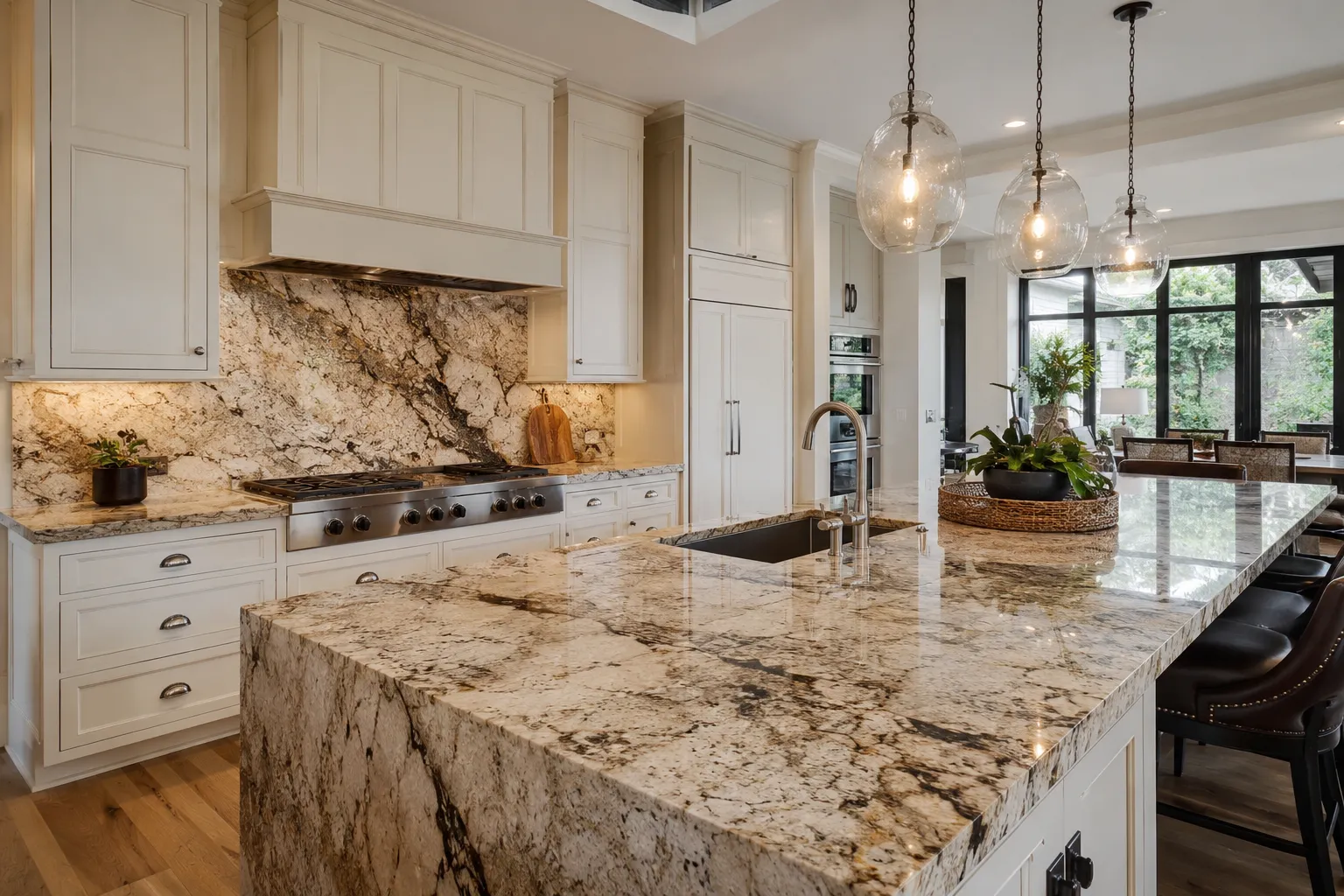
If you are planning a kitchen renovation, Granite countertop installation is one of the upgrades that can transform the look, function, and feel of the entire space, including kitchens and outdoor BBQ areas designed for entertaining. But getting a beautiful result involves much more than selecting an attractive slab.
Accurate measurements, cabinet preparation, sink and cooktop cutouts, seam placement, transportation, leveling, and finishing all affect the final result.
For homeowners in Kitchener, Waterloo, Cambridge, and surrounding Ontario communities, choosing an experienced countertop fabricator and professional countertop installer can make the process considerably more predictable. Cava Granite specializes in granite, quartz, and other countertop solutions for homes throughout the Kitchener-Waterloo and GTA areas.
What Is Granite Countertop Installation?
Granite countertop installation is the process of measuring, templating, fabricating, transporting, and securely fitting granite slabs to prepared kitchen cabinets. A professional project generally includes precise measurements, sink and appliance cutouts, edge finishing, seam preparation, leveling, securing, and a final inspection.
Granite is extremely durable, but it is also heavy and requires careful handling. An inaccurate template, inadequate cabinet support, or poorly executed cutout can create expensive problems.
That is why professional granite countertop installation should be treated as a coordinated process involving the homeowner, cabinet installer, fabricator, plumber, and countertop installer.
How Is Granite Installed?
Granite countertop installation involves measuring the kitchen, creating a precise template, fabricating the granite slab, cutting sink and appliance openings, transporting the pieces safely, positioning and leveling them on the cabinets, joining seams where necessary, and completing the final securing and finishing. Cost depends on stone selection, size, cutouts, edges, seams, access, and labour.
Why Proper Granite Countertop Installation Matters
A professionally installed countertop should look integrated into the kitchen rather than simply placed on top of the cabinets.
Proper granite countertop installation helps achieve:
- Accurate cabinet-to-countertop alignment
- Stable and visually clean seams
- Correct sink and cooktop openings
- Consistent overhangs
- Proper support for larger surfaces
- Clean finished edges
- A level, secure countertop
Granite can still chip or crack if it is improperly transported, unsupported, forced into an inaccurate opening, or subjected to excessive stress around cutouts.
The biggest advantage of professional installation is therefore risk reduction. You are not only paying for labour; you are paying for accurate fabrication, experienced handling, and a coordinated installation process.
How to Install Granite Countertops: Step-by-Step
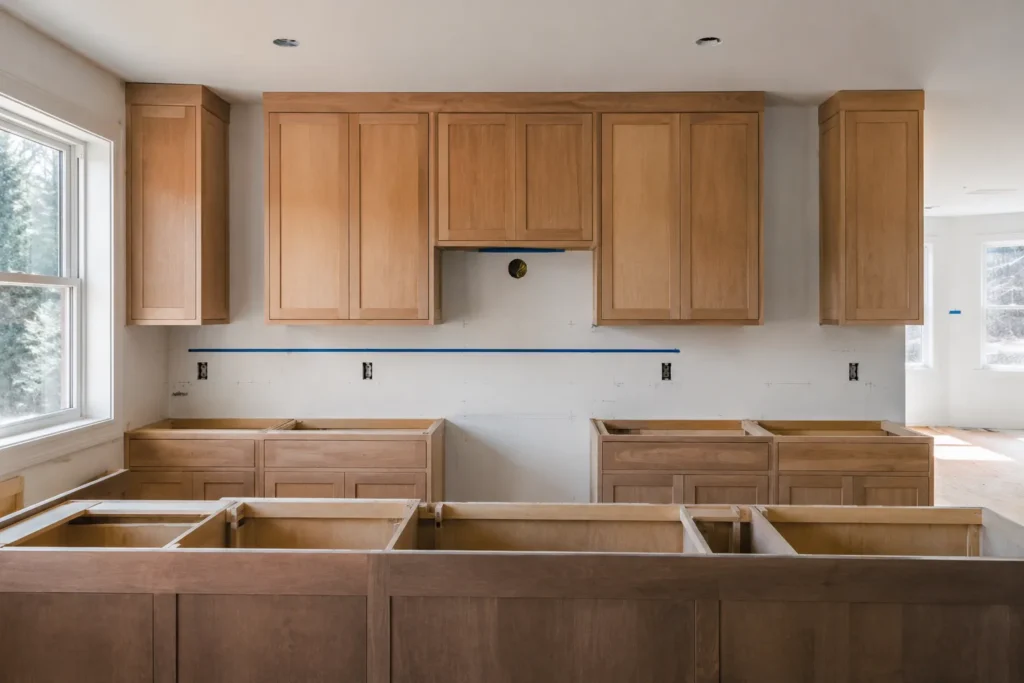
If you are researching how to install granite countertops, this is the typical professional workflow.
1. Inspect and Prepare the Cabinets
Before the stone arrives, base cabinets should be installed, secured, and properly aligned.
The installer checks:
- Cabinet level
- Cabinet stability
- Wall conditions
- Appliance locations
- Required countertop support
- Potential interference points
Cabinet preparation is one of the most important parts of granite countertop installation. Small variations may sometimes be accommodated, but major structural or leveling issues should be corrected before templating.
2. Complete Accurate Measurements
The next stage is professional measurement and templating.
Measurements typically account for:
- Wall lengths
- Corners
- Islands
- Overhangs
- Sink dimensions
- Faucet holes
- Cooktop openings
- Backsplash requirements
- Appliance clearances
Cava Granite states that it uses precise digital measurements and modern fabrication technology as part of its countertop process.
Accurate templating is critical because the fabricator uses these measurements to determine exactly how the slab will be cut.
3. Select and Plan the Granite Slab
Granite is natural stone, so every slab has its own colour variation, mineral movement, and pattern, making exotic granite an attractive option for homeowners looking for distinctive natural-stone character.
Slab planning should consider:
- Pattern direction
- Visual focal points
- Seam locations
- Island orientation
- Sink placement
- Available slab size
- The visual characteristics of statement stones such as Taj Mahal countertops
This is an often-overlooked part of granite countertop installation. Two slabs with similar colours can produce very different results depending on how they are positioned.
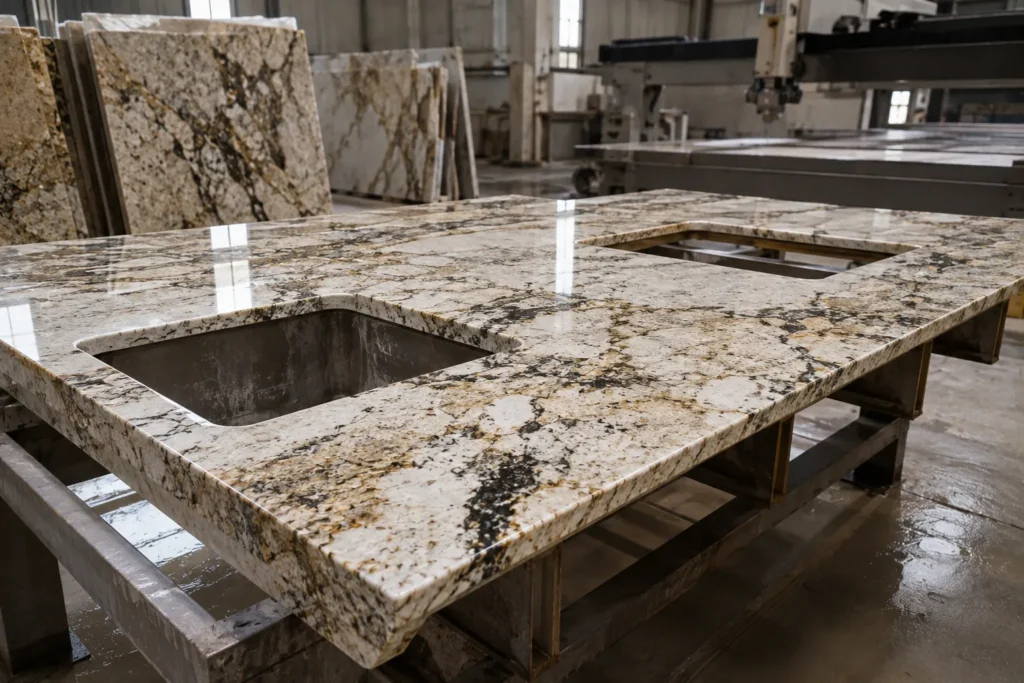
4. Fabricate the Countertop
After the measurements and slab layout are approved, the granite is fabricated.
Fabrication can include:
- Sink cutouts
- Faucet holes
- Cooktop cutouts
- Edge profiles
- Polishing
- Seam preparation
This is where measurement accuracy becomes especially important. Tight wall returns, islands, and multiple openings leave little room for error.
5. Plan Delivery and Handling
Granite is heavy and must be transported carefully.
Before delivery, the installation team should consider:
- Doorway dimensions
- Stairs
- Elevators
- Narrow hallways
- Tight corners
- Distance from vehicle to kitchen
Large granite pieces should be handled by an experienced team with appropriate equipment rather than treated like ordinary construction material.
6. Dry Fit the Countertop
The fabricated pieces are positioned before permanent securing.
This allows the installer to verify:
- Overall fit
- Wall alignment
- Seam positioning
- Sink opening
- Appliance clearances
- Overhangs
- Level
Professional granite countertop installation should never rely on forcing a poorly fitting piece into position.
7. Join Seams and Level the Surface
If multiple pieces are required, the installer carefully aligns and joins the seams.
Seam visibility depends on:
- Granite colour
- Pattern movement
- Lighting
- Seam location
- Workmanship
The countertop is also checked for proper level and support.
8. Secure and Finish the Countertop
Once everything is correctly positioned, the installer secures the countertop and completes the final finishing around edges, walls, sinks, and other interfaces.
A final inspection should check the seams, edges, cutouts, overhangs, and overall alignment.
How Much Does Granite Fitting Cost in Ontario?
Granite fitting cost varies significantly because every kitchen is different.
Home Depot Canada currently lists installed natural stone countertop pricing, including granite, at approximately $51–$114 per square foot, while noting that actual prices depend on material, project size, fabrication, delivery, installation, and additional features.
For a specific project, granite countertop installation pricing can be influenced by:
- Granite type and slab availability
- Total square footage
- Number of cutouts
- Sink configuration
- Edge profile
- Number of seams
- Backsplash requirements
- Island size
- Overhangs
- Existing countertop removal
- Delivery access
- Cabinet modifications
- Labour requirements
Instead of comparing companies only by price per square foot, ask for a written quote that explains exactly what is included.
A lower initial price may exclude demolition, premium edge profiles, difficult access, sink cutouts, or other project-specific work.
For homeowners in Kitchener, the most useful quote is the one that makes the complete project scope clear before fabrication begins.
Granite vs. Quartz for Kitchen Installation
Granite and quartz countertops can both be excellent countertop materials, but they have different characteristics.
| Feature | Granite | Quartz |
| Composition | Natural stone | Engineered stone |
| Appearance | Unique natural variation | More consistent patterns |
| Design | Every slab is different | Wide range of consistent styles |
| Maintenance | Requires appropriate stone care | Generally low maintenance |
| Best for | Natural character and variation | Consistency and convenience |
The right choice between granite and Mars Quartz depends on how you use your kitchen, your preferred aesthetic, and your maintenance expectations.
Regardless of material, accurate measurement and professional fabrication remain essential. Good granite countertop installation principles also apply broadly to other stone countertop projects.
What to Look for in Granite Installers Near Me
Searching for “granite installers near me” is easy. Choosing the right company requires more research.
Ask potential installers:
- Who performs the measurements?
- How is the template created?
- Where will the seams be?
- Which edge profiles are available?
- Are sink and cooktop cutouts included?
- What cabinet preparation is required?
- How will the slab be transported?
- Is countertop removal included?
- What warranty is provided?
- Who handles plumbing reconnection?
Experience with local homes can also matter. Older Kitchener-Waterloo properties may have walls and cabinetry that are not perfectly square, so installers should know how to work with real-world conditions.
Cava Granite has operated under its current brand and ownership since 2015 and specializes in countertop installation throughout Kitchener-Waterloo and the GTA.
Kitchen Installation Granite: How to Prepare
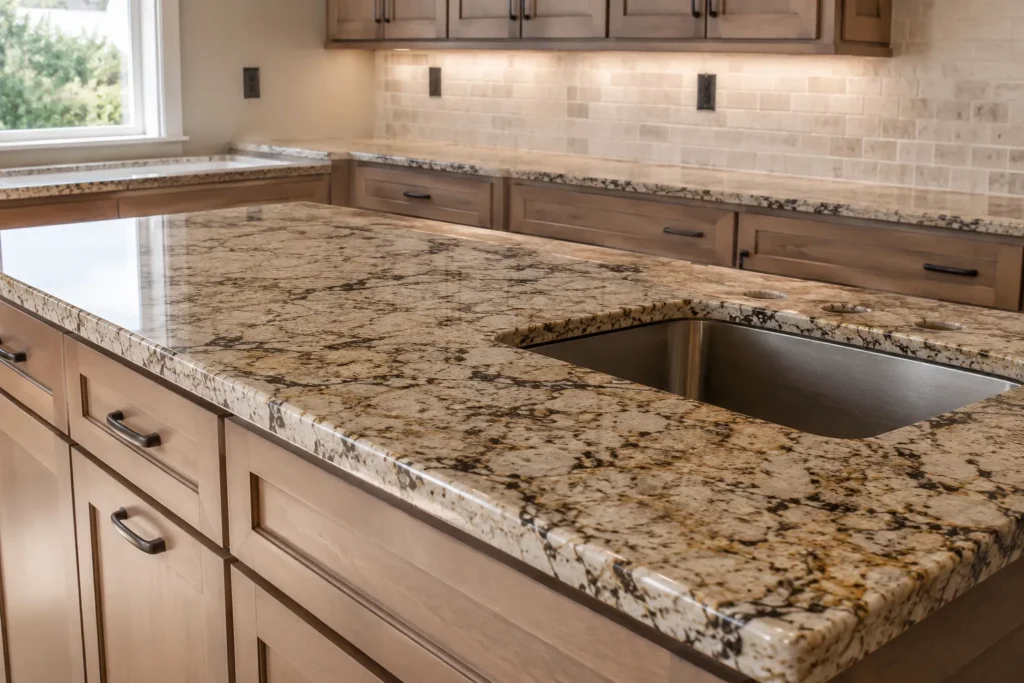
Good preparation makes granite countertop installation easier and helps prevent delays.
Before installation day:
- Confirm cabinets are installed and secured.
- Remove items from drawers and lower cabinets near the work area.
- Confirm appliance locations.
- Have sink and faucet specifications available.
- Discuss granite and quartz backsplash requirements.
- Confirm plumbing responsibilities.
- Clear the route into the kitchen.
- Keep children and pets away from the installation area.
Homeowners generally do not need to empty every cabinet, but clearing drawers and lower cabinets near the work zone can protect belongings from dust and give installers better access.
Before fabrication is finalized, also confirm the seam locations, overhangs, edge profile, and visual direction of the stone.
Common Granite Countertop Installation Mistakes
Measuring Too Early
If cabinets or appliances change after templating, the finished countertop may not fit correctly.
Choosing From a Small Sample Only
Granite is natural stone. A small sample cannot always show the full movement and variation of an exotic granite slab.
Ignoring Seam Placement
A seam placed in a highly visible location can become a distraction. Good granite countertop installation includes planning seams around the stone pattern and kitchen layout.
Treating Overhangs as Cosmetic
Large overhangs may require additional support depending on the configuration. The installer should evaluate the design before fabrication.
Choosing Only by Lowest Price
A cheaper quote may not include the same fabrication quality, cutouts, removal, finishing, warranty, or installation scope.
Scheduling Plumbing Too Tightly
Coordinate countertop installation with plumbing work so the sink and faucet can be properly connected and tested afterward.
Mid-Project Tip: Get the Scope in Writing
Before approving granite countertop installation, request a written project scope.
Confirm:
- Granite selection
- Thickness
- Edge profile
- Sink cutouts
- Faucet holes
- Cooktop cutouts
- Seam locations
- Backsplash
- Demolition
- Delivery
- Installation
- Required support
For homeowners in Kitchener, Waterloo, and Cambridge, Cava Granite offers local countertop consultation and installation services.
A clear scope helps prevent misunderstandings before fabrication begins.
How Long Does Granite Countertop Installation Take?
The physical installation may take one to several days depending on the complexity of the project, but the full timeline also includes measuring, fabrication, delivery, and scheduling.
Home Depot Canada advises allowing approximately two to four weeks after the measurement appointment for fabrication and delivery of natural stone countertops. Once fabricated countertops are ready, many installations can be completed within one to three days.
Complex kitchens may take longer because of multiple slabs, difficult access, unusual layouts, backsplash work, or coordination with other trades.
Granite Countertop Care After Installation
After granite countertop installation, everyday care is relatively simple when you follow recommendations for the specific stone and sealer.
The Natural Stone Institute recommends understanding the composition of your stone and selecting appropriate cleaning products. It also advises against using acidic cleaners as part of natural-stone care.
Practical habits include:
- Wipe spills promptly.
- Use cutting boards.
- Use trivets for hot cookware.
- Avoid abrasive cleaners.
- Follow sealing recommendations.
- Use stone-safe cleaning products.
Good maintenance is less about complicated routines and more about using the right products consistently. For additional guidance, the Natural Stone Institute’s granite countertop care recommendations cover daily cleaning, preventative measures, and sealing considerations.
Is DIY Granite Countertop Installation a Good Idea?
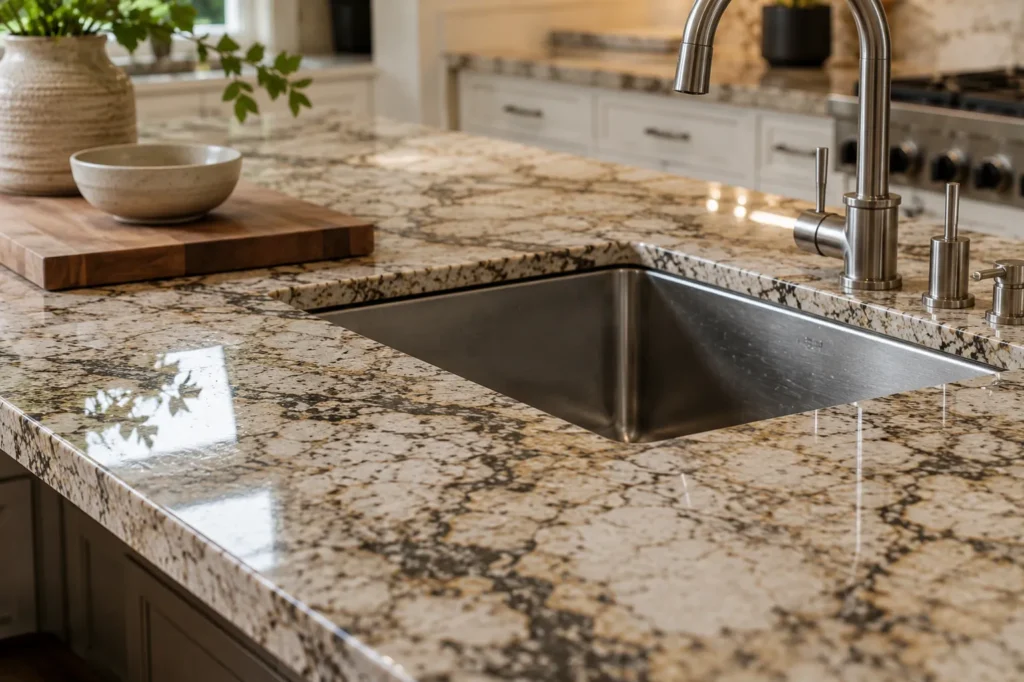
For most homeowners, DIY granite countertop installation is not an ideal place to save money.
Granite is heavy, difficult to maneuver, and unforgiving when measurements or cutouts are wrong. Professional fabrication also requires specialized equipment for cutting, polishing, and finishing stone.
A DIY project may only be practical for someone with substantial stone-fabrication experience, suitable equipment, sufficient help, and the ability to safely handle large slabs.
For a typical kitchen renovation, professional installation can reduce the risk of damaging an expensive slab or creating a fit problem that requires refabrication.
Why Choose Cava Granite in Kitchener?
Cava Granite provides a full-service countertop experience focused on material selection, fabrication, and professional installation. The company highlights quality materials, modern measurement and fabrication technology, and customer-focused service.
The company is located at 1358 Victoria St N, Kitchener, Ontario, providing local homeowners with an opportunity to discuss countertop options and project requirements.
Cava Granite serves Kitchener, Waterloo, Cambridge, and the GTA, making it a practical option for homeowners looking for a local countertop specialist.
The benefit of working with an established countertop company is coordination: material selection, measurement, fabrication, and installation can be planned as one connected project.
Frequently Asked Questions
1. How much does granite countertop installation cost?
Pricing depends on the stone, square footage, cutouts, edge profile, seams, delivery, site conditions, and labour. Canadian natural-stone installation pricing provides only a general benchmark, so a project-specific quote is more useful.
2. How long does granite countertop installation take?
Once fabricated countertops are ready, many projects can be installed within one to three days. Fabrication and delivery may add several weeks depending on material availability and project complexity.
3. Can granite countertops be installed over existing cabinets?
Yes, provided the cabinets are structurally sound, securely installed, properly supported, and suitable for the new countertop. The installer should inspect them before templating.
4. Is granite difficult to maintain?
No. Routine maintenance is generally straightforward when appropriate stone-safe products are used and the fabricator’s care recommendations are followed. Acidic and abrasive cleaners should generally be avoided.
5. Should I choose granite or quartz?
Choose granite if you value natural variation and the unique character of a natural stone slab. Quartz may be preferable if you want engineered consistency and low-porosity performance.
6. How do I find reliable granite installers near me?
Compare installers based on measurement accuracy, fabrication capability, installation experience, project scope, warranty, communication, and completed work—not simply the lowest price.
7. How should I prepare my kitchen before granite countertop installation?
Before installation, make sure the cabinets are securely installed and level, appliance locations are confirmed, and the installation route is clear. Remove items from nearby drawers and lower cabinets, and have your sink and faucet specifications ready. It is also helpful to confirm seam locations, overhangs, edge profiles, backsplash requirements, and plumbing responsibilities with the installer before installation day.
8. Do granite countertops need support for an overhang?
Large granite overhangs may require additional structural support depending on their size, configuration, and use. Your countertop installer should evaluate the overhang during the design and templating stage and recommend appropriate support before fabrication. Planning support in advance helps reduce stress on the granite and protects against potential cracking or damage.
9. What happens if my kitchen walls or cabinets are not perfectly square?
Professional granite countertop installers can typically accommodate minor variations in walls and cabinetry through accurate templating and fabrication. However, significant cabinet instability, unevenness, or structural problems should be corrected before the countertop is fabricated. A professional site assessment helps identify potential fitting issues early and prevents costly modifications later.
10. Can I use my kitchen immediately after granite countertop installation?
In most cases, the countertop can be used once the installation and finishing work are complete, but certain areas may require additional time before heavy use or plumbing reconnection. Your installer should provide specific guidance regarding seams, adhesives, sink installation, and cleaning after the project. Following those instructions helps ensure the countertop settles and performs properly.
Final Thoughts
A successful granite countertop installation begins long before the stone reaches your kitchen. Accurate measurements, thoughtful slab selection, careful fabrication, proper cabinet preparation, safe handling, precise fitting, and a final quality inspection all contribute to the finished result.
For homeowners in Kitchener, Waterloo, Cambridge, and surrounding Ontario communities, choosing a local countertop specialist can also make communication, measurement, consultation, and project coordination easier.
If you are planning a kitchen renovation, visit Cava Granite at 1358 Victoria St N, Kitchener, or contact the team to discuss your countertop requirements, stone options, measurements, and installation needs.
The right countertop is not simply about choosing a beautiful slab. It is about making sure that slab is measured, fabricated, fitted, and finished correctly.