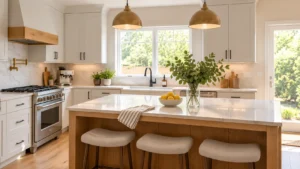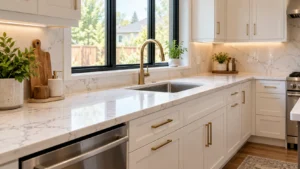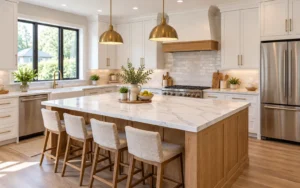
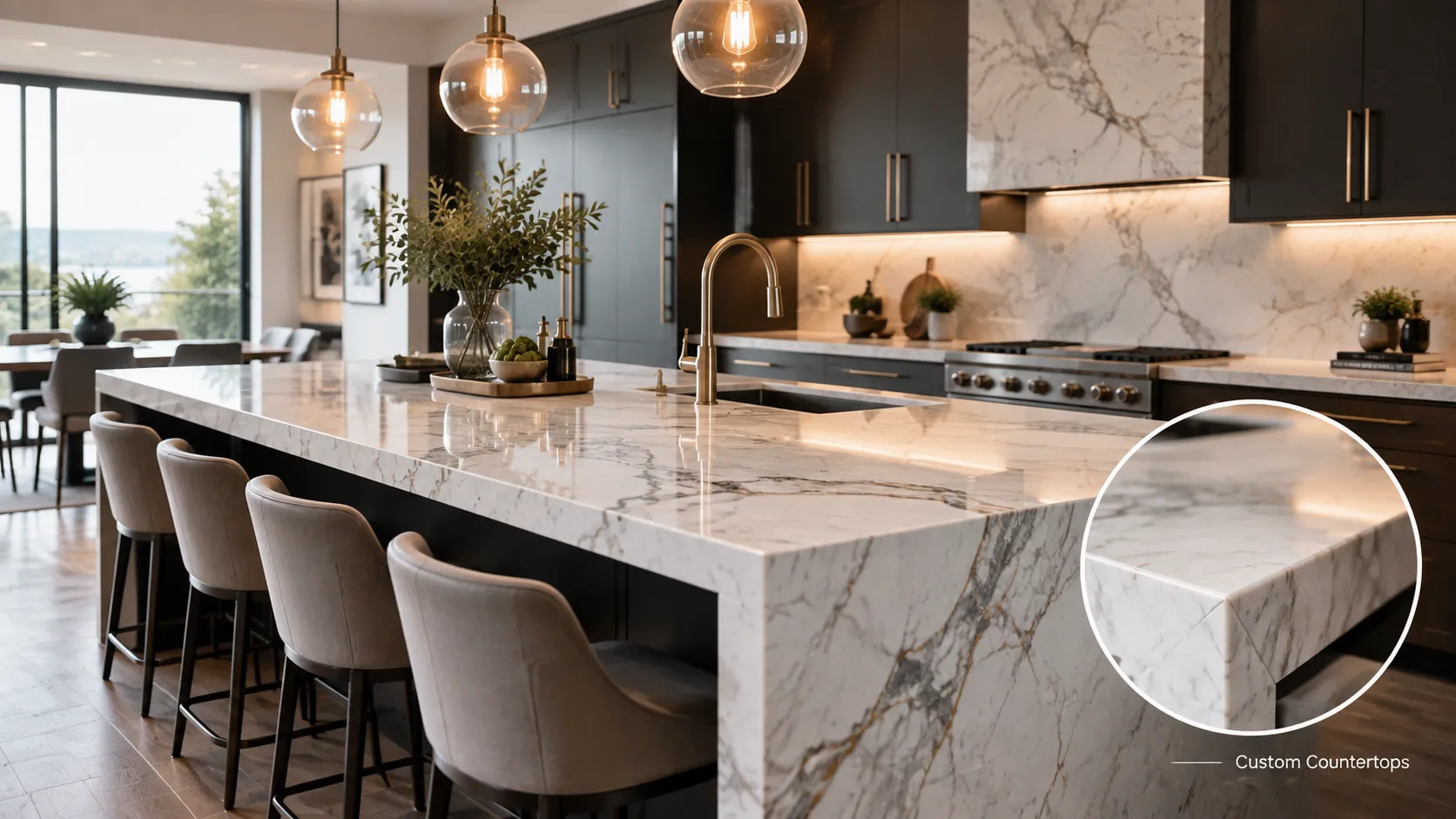
Choosing custom kitchen countertops is about much more than picking a colour that looks good in a showroom. The right surface needs to fit your kitchen layout, cabinetry, sink, appliances, cooking habits, maintenance expectations, and overall design.
For homeowners in Kitchener, Waterloo, Cambridge, and Guelph, Cava Granite combines countertop design, precision fabrication, and professional installation to create surfaces tailored to individual spaces. Cava Granite has operated under its current brand and ownership since 2015 and specializes in quartz, granite, marble, and other stone countertop solutions.
Whether you’re renovating an existing kitchen or building a new one, this guide explains how to evaluate materials, measurements, edge profiles, finishes, islands, sink cutouts, maintenance requirements, and installation details before making a decision.
What Are Custom Kitchen Countertops?
Custom stone countertops are surfaces measured, fabricated, cut, finished, and installed specifically for a particular kitchen rather than selected as a standard prefabricated size. They can accommodate unusual wall dimensions, islands, sink openings, cooktops, backsplashes, corners, waterfalls, and other design requirements.
That makes custom kitchen countertops particularly useful when your kitchen has an irregular footprint or when you want the countertop to become a major architectural feature.
Unlike simply buying a slab and having it placed on cabinets, a properly planned countertop project considers:
- Exact cabinet dimensions
- Wall and corner conditions
- Sink and faucet locations
- Cooktop openings
- Appliance clearances
- Backsplash requirements
- Edge profiles
- Overhang dimensions
- Veining and slab orientation
- Seams and their placement
- Material characteristics
- Installation access
The result is a surface designed around the kitchen rather than forcing the kitchen to accommodate a standard countertop.
Why Choose Custom Countertops for a Kitchen?
The biggest advantage of custom kitchen countertops is control.
A standard solution may work perfectly in a straightforward kitchen, but custom fabrication gives homeowners greater flexibility over appearance and functionality.
1. Better Fit
Made-to-order countertops can be fabricated according to the actual dimensions of your kitchen.
This is especially valuable when walls aren’t perfectly square, cabinets have different depths, or an island requires a specific overhang.
2. More Design Freedom
With custom kitchen countertops, homeowners can select material, colour, edge profile, thickness, finish, backsplash integration, sink cutouts, and other details.
You can create anything from a minimalist white quartz island to a dramatic natural-granite focal point.
3. Better Use of Space
A custom design can help maximize usable preparation space without unnecessarily increasing the countertop footprint.
For example, a homeowner might extend an island overhang to create seating while keeping adequate circulation around the island.
4. A More Cohesive Kitchen
The countertop should work with the cabinets, backsplash, flooring, hardware, lighting, and appliances.
Rather than choosing each component independently, think of the kitchen as one visual system.
Choosing the Right Material

Material selection is one of the most important decisions you’ll make.
Different surfaces offer different combinations of appearance, durability, maintenance, heat resistance, stain resistance, and design consistency.
Quartz
Quartz countertops are an engineered stone surface commonly selected for kitchens because it offers a broad range of colours and patterns with relatively low day-to-day maintenance.
Cava Granite supplies and fabricates quartz surfaces for residential and commercial applications throughout Kitchener, Waterloo, Cambridge, and Guelph. Its quartz offering includes contemporary colours, neutral designs, and marble-inspired patterns.
Quartz is particularly attractive for homeowners who want:
- Consistent patterns
- Low-maintenance everyday use
- Contemporary styling
- Marble-inspired aesthetics
- A wide design selection
However, homeowners should still follow the care instructions supplied for their specific product.
Granite
Granite is natural stone, meaning each slab has its own mineral composition, colour variation, and pattern.
That natural variation is one of its greatest design advantages.
The Natural Stone Institute describes granite as a hard and durable stone suitable for heavily used surfaces, including kitchen countertops. It also recommends avoiding direct localized heat despite granite’s generally strong heat resistance.
Granite can be an excellent choice if you value:
- Natural variation
- Distinctive slab character
- Strong scratch resistance
- Heat resistance
- Traditional or contemporary styling
Cava Granite offers custom granite fabrication and installation for kitchens, bathrooms, laundry rooms, bars, fireplaces, and other spaces.
Quartzite, Marble, and Other Stones
Other natural stones can provide distinctive aesthetics and performance characteristics.
The important point is that natural stone should not be treated as one uniform category. Geological composition affects how a material responds to acids, moisture, heat, cleaning products, and staining.
The Natural Stone Institute recommends understanding the specific stone before selecting cleaning products or maintenance procedures.
For that reason, ask the fabricator about the exact slab rather than relying only on a generic statement such as “natural stone is easy to maintain.”
Custom Countertops Kitchen Design: What Should You Customize?

When planning custom kitchen countertops, start with function before aesthetics.
Ask yourself how the kitchen will actually be used.
Do you cook frequently? Do several people prepare food simultaneously? Do children use the island? Is the island primarily for entertaining? Do you need seating? Where will small appliances live?
These questions influence the design.
Countertop Thickness
Thickness affects the visual character of the kitchen.
A substantial edge can create a strong architectural appearance, while a thinner profile may suit minimalist interiors.
The apparent thickness can also be influenced by fabrication techniques and edge construction, so discuss the desired look with your fabricator before finalizing the design.
Edge Profiles
Common countertop edge options include:
- Eased
- Beveled
- Bullnose
- Ogee
- Waterfall
- Mitered
A simple eased edge often suits contemporary kitchens, while more decorative profiles may work better with traditional cabinetry.
The edge should also make practical sense for the location. A busy walkway may benefit from a softer, simpler profile.
Sink Cutouts
Sink selection should happen early enough for the countertop fabricator to account for the exact model and dimensions.
Undermount, top-mount, and farmhouse sinks can require different fabrication approaches.
Never assume that a generic sink opening will fit the final sink perfectly.
Island Overhangs
Kitchen islands often serve multiple purposes: food preparation, casual dining, storage, entertaining, and visual separation.
A carefully planned overhang can turn part of an island into comfortable seating.
However, larger overhangs may require additional structural support. Your countertop professional and cabinet installer should coordinate this before fabrication.
How the Custom Countertop Process Works

A professional countertop project usually follows a sequence rather than simply measuring and cutting a slab.
Step 1: Consultation
Discuss your kitchen layout, design preferences, budget, material choices, appliances, sink, backsplash, and expected use.
Step 2: Material Selection
Compare actual slabs whenever possible.
This is especially important with natural stone because the finished countertop can look substantially different from a small sample.
Step 3: Measurement and Templating
Accurate measurements are critical.
Cava Granite uses digital measurement and templating as part of its fabrication process, helping account for the actual dimensions of the project.
Step 4: Fabrication
The selected slab is cut according to the project specifications.
This can include:
- Sink openings
- Cooktop openings
- Faucet holes
- Backsplash pieces
- Edge profiles
- Seams
- Waterfall panels
Step 5: Quality Inspection
Before installation, fabricated components should be checked for dimensions, edge finishing, openings, and visible defects.
Step 6: Installation
The finished pieces are transported to the property and installed.
Professional installation matters because even an excellent slab can look poor if seams, leveling, support, or finishing are handled incorrectly.
Cava Granite provides professional countertop installation across Kitchener, Waterloo, Cambridge, and Guelph.
Custom Granite Kitchen vs. Quartz: Which Is Better?
There isn’t one universally “best” countertop.
The better choice depends on the priorities of your household.
| Consideration | Granite | Quartz |
| Material | Natural stone | Engineered stone |
| Appearance | Naturally unique | More consistent |
| Design variation | High | Broad selection with predictable patterns |
| Maintenance | Depends on stone and finish | Generally straightforward |
| Heat considerations | Strong heat resistance, but avoid thermal shock | Follow manufacturer guidance |
| Best for | Natural character | Consistent modern design |
| Custom fabrication | Yes | Yes |
If you love the individuality of natural stone, granite may be the better fit. If you prefer predictable colour and pattern with a low-maintenance routine, quartz may be more appealing.
The decision should be based on your lifestyle rather than simply following the latest kitchen trend.
Made-to-Order Countertops: What Actually Adds Value?
The value of made to order countertops isn’t simply that they’re “custom.”
The real advantage is solving specific design and functional problems.
For example, imagine a Kitchener kitchen with:
- An L-shaped cabinet layout
- A large island
- A farmhouse sink
- A wall-mounted range hood
- Limited clearance near a doorway
- Seating on one side of the island
A generic countertop solution could leave compromises around seams, overhangs, or appliance openings.
A properly planned custom fabrication process can coordinate these elements from the beginning.
That is where custom kitchen countertops become more than a decorative upgrade they become part of the kitchen’s functional design.
How to Maintain Your Countertops
Maintenance depends on the material.
For natural stone, the Natural Stone Institute recommends using cleaning products appropriate for the stone’s composition and warns that acidic products can damage acid-sensitive stones. It also recommends trivets or mats when appropriate because localized heat can create problems.
Good Everyday Habits
- Wipe spills promptly.
- Use manufacturer-recommended cleaners.
- Use cutting boards instead of cutting directly on the countertop.
- Use trivets for hot cookware.
- Avoid harsh abrasive cleaners.
- Don’t assume every natural stone needs the same maintenance.
- Ask whether your specific material benefits from an impregnating treatment.
Sealing is also frequently misunderstood. The Natural Stone Institute explains that sealing does not make stone completely stain-proof; appropriate treatments can improve stain resistance depending on the material.
Common Mistakes to Avoid
Even beautiful custom kitchen countertops can disappoint when planning is rushed.
Choosing From a Tiny Sample
A small sample cannot always communicate the movement, veining, or colour variation of an entire slab.
Selecting the Countertop Too Late
Countertop dimensions interact with sinks, appliances, cabinets, backsplash details, and electrical planning.
Ignoring Seams
Seams cannot always be eliminated. The goal is to plan them intelligently and place them where they are least visually disruptive.
Treating All Stone the Same
Granite, marble, quartzite, quartz, and other surfaces have different characteristics.
Focusing Only on Price
A cheaper quote may not provide the same material, fabrication detail, edge treatment, templating, installation quality, or project coordination.
When comparing quotes, compare the complete scope not just the number at the bottom.
A Practical Buying Checklist
Before ordering custom kitchen countertops, confirm these details:
- Countertop material selected
- Actual slab reviewed where appropriate
- Cabinet installation completed or ready for templating
- Sink model confirmed
- Faucet locations confirmed
- Cooktop dimensions confirmed
- Edge profile selected
- Countertop thickness confirmed
- Island overhang discussed
- Backsplash requirements confirmed
- Seam locations discussed
- Maintenance requirements understood
- Installation process explained
- Quote scope reviewed
Planning a Kitchen in Kitchener?
If you’re renovating in Kitchener, visiting a local countertop showroom can make material selection easier because you can see full slabs, discuss fabrication options, and review practical installation considerations in person.
Cava Granite’s showroom is located at 1358 Victoria St N, Kitchener, ON N2B 3E2. The company serves Kitchener, Waterloo, Cambridge, Guelph, and surrounding areas.
Ready to compare your options? Contact Cava Granite for a consultation and discuss your kitchen layout, preferred material, design requirements, and fabrication needs before committing to a countertop.
Why Professional Fabrication Matters

The material is only one part of the finished result.
Professional fabrication determines how accurately the slab is cut, how edges are finished, how sink and cooktop openings are produced, and how individual pieces come together.
Cava Granite’s process includes material selection, digital measurements, fabrication, polishing and edge finishing, quality inspection, delivery, and installation.
For complex custom kitchen countertops, that end-to-end coordination can be particularly valuable.
A good fabricator should be willing to explain why a particular material, edge, seam location, or support method is appropriate rather than simply selling you the most expensive option.
Frequently Asked Questions
Are custom kitchen countertops worth it?
Yes, particularly when your kitchen has an unusual layout, large island, special sink, unique dimensions, or specific design requirements. Custom fabrication allows the countertop to be designed around the actual space.
What is the difference between custom countertops and standard countertops?
Standard countertops are generally produced around predetermined dimensions or configurations. Custom countertops are measured and fabricated for a specific project, allowing greater flexibility for layouts, cutouts, edges, seams, and design details.
Are granite countertops good for busy kitchens?
Granite can be an excellent option for busy kitchens because it is a hard natural stone with strong resistance to everyday wear. However, appropriate care and protection from direct localized heat are still recommended.
Is quartz easier to maintain than granite?
Quartz is often selected for its straightforward everyday maintenance and non-porous surface characteristics. Granite maintenance depends on the specific stone and whether additional stain-resistance treatment is appropriate. Always follow the care guidance for the exact product.
How long does a custom countertop project take?
The timeline depends on material availability, cabinet readiness, templating, fabrication complexity, installation scheduling, and project size. A professional fabricator can provide a more accurate timeline after reviewing the project.
How do I choose between granite and quartz?
Start with your priorities. Choose granite if natural variation and stone character are important. Consider quartz if you want consistent patterns, a broad design selection, and straightforward daily care. Then compare specific products rather than choosing solely by material category.
Conclusion: Design the Countertop Around Your Kitchen
The best custom kitchen countertops are not necessarily the most expensive or trendiest. They are the ones that fit the space, support the way you cook and live, complement the rest of the kitchen, and are fabricated and installed with care.
Start by identifying your functional requirements. Then compare quartz, granite, and other appropriate materials based on appearance, maintenance, durability, and lifestyle. From there, finalize the measurements, edge profile, sink openings, overhangs, seams, and installation details.
For homeowners searching for custom kitchen countertops in Kitchener and the surrounding Waterloo Region, Cava Granite provides kitchen countertop design guidance, precision fabrication, and professional installation from its Kitchener location.
If you’re ready to turn your kitchen measurements and design ideas into a practical countertop plan, contact Cava Granite for a consultation and explore the material options available for your project.